
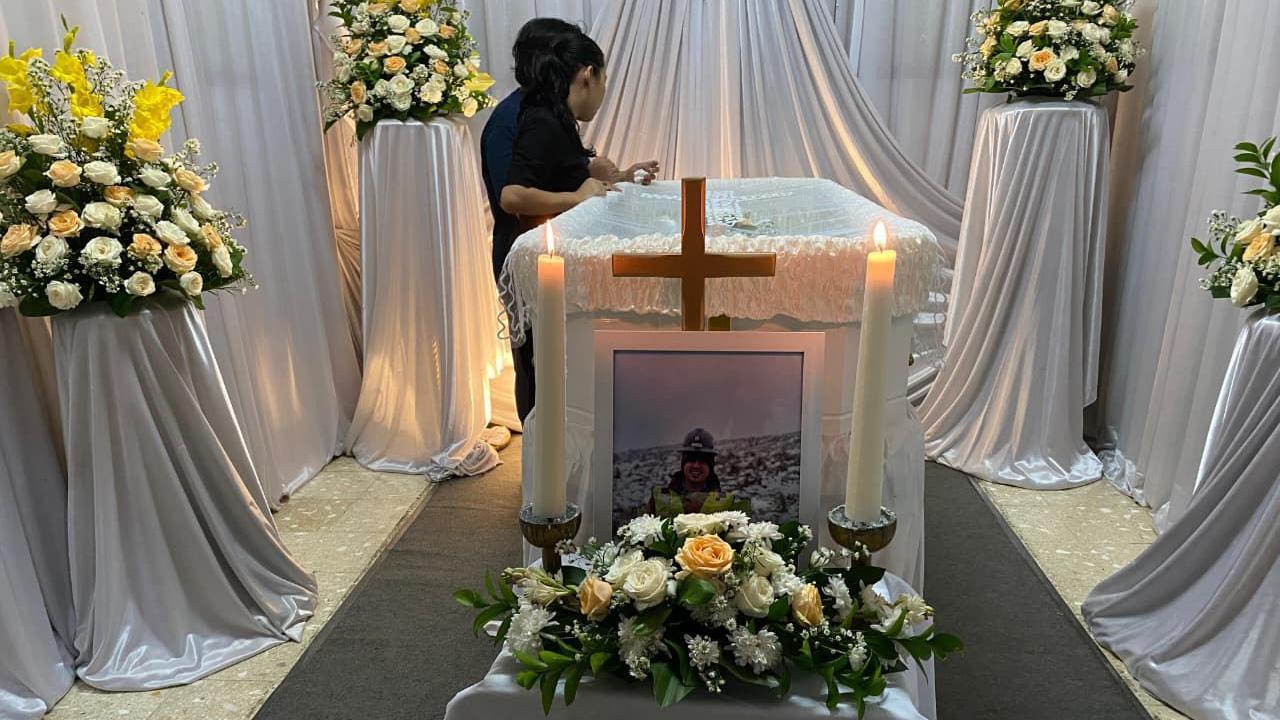
The unexplained death of Simson Mulia, an employee of PT Freeport Indonesia, on Wednesday, March 11, continues to spark profound questions. He was fatally shot by unidentified individuals within the Freeport operational area, a site designated as a national vital object. This highly guarded location is protected by thousands of security personnel, with annual security costs exceeding Rp1 trillion. The central question remains: will the full truth of this incident be brought to light in a court of law?
Simson Mulia served as a senior engineer in PT Freeport Indonesia’s Hydrology Department. On the morning of March 11, from his workplace near Mount Nemangkawi—also known as Puncak Jaya or Carstenz Pyramid outside the Amungme indigenous community—Simson spoke with his wife, who resides in Bandung, West Java. Their conversation covered various topics, including Simson’s plan to head to his work location that day.
According to Freeport’s report, Simson was scheduled to conduct hydrological inspections around the Grasberg open-pit mine in Mimika Regency that morning. Freeport had ceased exploitation of this open-pit mine in 2020, as its surface gold and copper reserves, initially extracted in 1991, had been depleted.
Around 8:30 AM Eastern Indonesian Time, Simson was situated in the limestone exploitation area, specifically the Jayapura Lime Quarry, located at the northern edge of Grasberg. This Freeport work area, home to limestone crushing and refining installations, lies directly beneath a towering range of vertical limestone mountains north of Grasberg.

At this particular location, Simson was not alone; he was working alongside his colleague, Abraham Marindal. In the moments leading up to his death, Simson was in the bed of a Freeport operational pickup truck, identified by its hull number LV-4446, while Abraham sat in the driver’s seat.
Suddenly, two gunshots rang out. Abraham froze, then saw Simson collapse, bleeding, with his helmet dislodged from his head. Abraham quickly activated his handy talkie, contacting colleagues at the office to request evacuation assistance. Following this, he sought cover to shield himself from potential further gunfire.


Responding to Abraham’s urgent call, a contingent of Brimob personnel rapidly mobilized towards the Jayapura Lime Quarry. Upon the arrival of the fully armed police officers at the site, several more gunshots were reportedly fired. This information was affirmed by Brigadier General Faizal Ramadhani, the leading figure in Satgas Cartenz—a joint police and TNI task force operating in Papua.
Two videos provided by Faizal to the press show several Brimob members taking cover behind vehicles and rocks. A voice recording the video can be heard saying, “Repeated gunfire is heard.” The Brimob personnel in the video are heard questioning each other about the direction of the shots, with one stating, “From our direction, 11 o’clock.” Meanwhile, other Brimob personnel were crouched behind rocks, facing the limestone mountains. As of now, BBC News Indonesia has been unable to verify the authenticity of these two videos, and Simson is not visible in either.

Faizal stated that his personnel transported Simson to the SOS International Hospital, located in Freeport’s employee settlement in Tembagapura, around 10:05 AM. Faizal claimed that medical workers attempted life-saving measures for Simson. However, approximately two hours after the shooting, the 48-year-old man succumbed to his injuries. According to the police, Simson was shot in the left ear.
Abraham Marindal stands as the sole key witness to this tragic event. He was not shot, but his palm was injured when he fell while attempting to save himself. Since the shooting incident, Abraham has not appeared in public. Police claim he is suffering from trauma, which has consequently delayed the process of gathering his testimony.
While shocking, this is not the first such incident to occur.
The incident involving Simson has deeply shocked his family. A close relative described the event as “tragic and dramatic.” “We are shocked by his death in such a manner,” said Simson’s relative, who requested anonymity for personal safety. We met the relative at the APK Santo Yusuf Funeral Home in Bandung, where Simson’s body was laid to rest before his burial on Saturday, March 14.
However, Simson is not the only employee to have died from a gunshot within Freeport’s territory. A similar fate befell Graeme Thomas Wall, a New Zealand national working for Freeport, on March 30, 2020. Graeme was fatally shot by “unidentified individuals” who infiltrated Freeport’s office complex in Kuala Kencana. Graeme died from a gunshot wound to his left chest.

Unlike Grasberg, which is nestled in the mountains, Kuala Kencana, which also features residential areas, a golf course, and other recreational facilities for Freeport employees, is located approximately 30 minutes from Timika city center. Nevertheless, both Grasberg and Kuala Kencana are designated as state vital objects. This means they are not only guarded by security forces but also supposedly accessible only to individuals possessing official identification cards or holding formal invitations from Freeport.
“Within this company area, there is a double security system,” stated an anonymous Freeport worker, adding, “There is a layered security system.”
What does security at Freeport entail?
At least 1,600 police and military personnel are deployed to guard Freeport’s operational and supporting areas in Mimika. This figure is based on a public report published by the company in 2025. Of this number, 758 are police officers from the Brimob Corps, who conducted security operations under Satgas Amole between November 2025 and May 2026. In the Amungme language, ‘Amole’ is a term of address. Almost every year, Brimob rotates its personnel assigned to the Freeport area, a practice also followed by the TNI.
During the departure ceremony for Brimob personnel heading to Freeport in April 2023, the institution’s highest-ranking officer, Commissioner General Anang Revandoko, remarked, “The problems in Papua are very, very complex, compounded by its natural conditions.”

In addition to state security forces, Freeport also employs 410 staff security officers and 655 security guards supplied by contractors or third-party agencies. Both categories of security personnel are reportedly unarmed. “This security arrangement is necessary to enhance the protection of our employees, contractors, and assets, especially given the security challenges and the remote and difficult terrain,” Freeport stated in its report.
We submitted inquiries regarding the implementation and effectiveness of the security system to Freeport via written letter. In their response, Freeport stated that all their work areas are guarded as vital objects by state apparatus from the Indonesian National Police (Polri) and the Indonesian National Armed Forces (TNI). They asserted that their security schemes are always based on Presidential Decree Number 63 Year 2004 concerning the security of national vital objects. This regulation stipulates that Polri “must provide security assistance,” and it allows for TNI involvement “in accordance with applicable regulations.”
A former Freeport employee indicated that the majority of guard posts within the company area are staffed by Brimob members, while military posts are positioned outside the mining region.

According to Brigadier General Alfred Papare, during his tenure as Central Papua Police Chief last November, Brimob members were assigned to almost all Freeport areas—extending from the port and power plant in the coastal area of Amamapare, the Kuala Kencana housing complex, to the mining areas in the mountains. Brimob members, Alfred added, also guarded the cable car location in Tembagapura, which leads to the Grasberg open-pit mine. Aside from traveling by four-wheel-drive vehicles (light vehicles/LV), this cable car represents the sole access to Jayapura Lime Quarry and other facilities around the Grasberg open-pit mine, such as the Freeport Mining Museum.
“To go up to Grasberg using the cable car, access requires a Freeport ID card,” said a former employee of one of the world’s largest gold mining companies. “If using an LV car, it’s the same; they will still check ID cards,” he added. Journeys to the Grasberg open-pit mine and the mining museum are almost always on the agenda for visits organized by Freeport, whether for state officials or external parties such as influencers and the press. When he was president, Joko Widodo visited Grasberg and the mining museum on September 1, 2022. The location of Simson’s shooting is approximately two kilometers from this museum.

The involvement of the military in Freeport’s security operations was formalized through a memorandum of understanding (MoU). Tony Wenas, President Director of Freeport Indonesia, signed this agreement with the TNI Commander—then General Hadi Tjahjanto—in December 2019. The agreement regarding military involvement was further renewed by the two institutions in May 2022. General Andika Perkasa, who was then the TNI’s top official, stated in a meeting with Freeport’s board of directors two months prior, “Tactical considerations must come from us because we are in charge of the field, so personnel matters and post placements must be determined by us, not by Freeport’s considerations.” In that meeting, Andika also requested that Freeport “provide support in the form of communication equipment for TNI personnel joining the task force.” “Our duty is to secure national vital objects. I want everything to be transparent, especially regarding the fulfillment of soldiers’ rights,” Andika asserted.
What is the cost of Freeport’s security?
In 2024, Freeport allocated US$89 million, equivalent to Rp1.5 trillion, for the security of its operational and supporting areas in Mimika. Of this amount, Freeport claimed that Rp441.6 billion was designated as “support costs” for state apparatus, namely the police and military. From this sum, 57% was “channeled directly to Polri, which holds primary responsibility for securing Grasberg.”
In a report they published in 2025, Freeport stated that 71% of the total budget for Polri and TNI was “provided in kind, such as food, housing facilities, fuel, travel expenses, and vehicle repairs.” Expenditures for food, Freeport noted, consumed the largest allocation. “The remainder we provide in the form of cash allowances for police and military units,” Freeport wrote. This category of expenditure includes, among other things, costs incurred by the police and TNI for community assistance programs, as well as monthly allowances for police and soldiers “to alleviate the difficulties of assignment in remote locations and provide basic living allowances.”

Freeport claims that all monthly allowances for police and soldiers guarding their area are disbursed through a single channel, specifically the central government in Jakarta. In their annual report, Freeport states that it “does not provide any ammunition, lethal or non-lethal, and does not exercise command or control over the Indonesian military or police.”
Beyond expenditures for police and military personnel, Freeport spent approximately Rp1 trillion on internal security budgets during 2024, involving three companies that collaborate with them. One such private security service company at Freeport is PT Nawakara Perkasa Nusantara, a corporation established in 1996 by several police generals.

Given the trillions in budget and thousands of security personnel, why then can unidentified armed individuals enter Grasberg and shoot a Freeport employee? “Please give us time [to answer] because we need a thorough investigation process,” said Commissioner Jeremias Rontini, Central Papua Police Chief, via text message.
Read related articles on various other shooting incidents at Freeport:
- Projectile from military found at shooting site of two US teachers in Grasberg in 2002
- Antonius Wamang and other mysterious shooters in Grasberg
- Two Freeport employees found dead in a burning car
- Papuan woman died, allegedly due to mistaken shooting by security forces
As a police officer, Rontini possesses extensive experience with Freeport-related issues. Having built his career in Brimob, Rontini served as Deputy Chief of Mimika Police in 2008. When a soldier was shot at kilometer 41 on a Freeport road in October 2013, Rontini had become the Chief of Mimika Police. Six months earlier, two pieces of Freeport heavy equipment on kilometer 36 road were also burned. We inquired with Rontini why security incidents continue to occur in the Freeport area despite the security system being “continuously improved.” “Mimika then was different from now,” Rontini stated, declining to elaborate further on his remark.
Alleged perpetrator previously declared dead and the story of mistaken arrests.
In the shooting case involving Simson Mulia, Commissioner Yusuf Sutejo, spokesperson for Satgas Cartenz, accused the pro-independence militia, the West Papua National Liberation Army (TPNPB)—which he referred to as an armed criminal group. TPNPB spokesperson, Sebby Sambom, has not been able to confirm whether the shooting was carried out by his organization. The reason, he stated, is that TPNPB militia members who typically gather information in Mimika were arrested by authorities early last March. “We are having difficulty getting PIS (intelligence) reports from the Timika and Tembagapura areas,” Sebby conveyed via audio recording.

Exactly one month before the shooting at Jayapura Lime Quarry that killed Simson, a security incident occurred on kilometer 50 road, between Kuala Kencana and Tembagapura. A soldier from the Tembagapura Koramil, Sergeant Major Arifin Cepa, died in that event. Hours after the incident, Lieutenant Colonel Tri Purwanto, spokesperson for the Cenderawasih Military Command, distributed a press statement to journalists. He stated that Arifin Cepa died inside a car while on patrol. Tri said Arifin died in a firefight with TPNPB militia. In addition to Arifin, another soldier driving the patrol car, Sergeant First Class Hendrikus, suffered bleeding from his nose.
However, different information was provided by Satgas Cartenz on March 7. Based on their investigation, the task force claimed, Arifin Cepa died not from a firefight, but from an attack using a bayonet.

In a written statement also disseminated to the press, Satgas Cartenz stated that the perpetrator who attacked Arifin was Jeki Murib. Jeki, according to the Habema Operations Command formed by the TNI, had already been killed by military personnel in Omikia District, Puncak Regency, in July 2025. According to Satgas Cartenz, on February 11, Jeki rode in the car driven by Sergeant First Class Hendrikus—which was also occupied by Sergeant Major Arifin Cepa and several civilians, including a Freeport contractor employee. Police stated that Jeki concealed a bayonet inside his shoe, which Arifin and Hendrikus did not realize. When they stopped at the kilometer 50 rest area, according to the police, Hendrikus even gave Jeki a helmet—who then allegedly immediately attacked the sergeant first class. Arifin, who was in the car at the time, was simultaneously attacked by TPNPB militia members who were disguised and also riding in the Freeport operational vehicle.

Regarding the attack incident that killed Arifin, on March 2, TNI Koops Habema briefly arrested six indigenous Papuans—on suspicion of involvement and conspiracy with Jeki Murib. The soldiers brought these six individuals to the Kodim 1710/Mimika Headquarters, with their eyes taped and their hands tied behind their backs. However, a day after the arrest, the six individuals were released. Anton Alom, a member of the Mimika DPRD and a retired soldier, advocated for them. Anton stated that they were civilians, not TPNPB militia members. One of them, Anton mentioned, named Wainus Kogoya, even held the position of neighborhood chief in a settlement in Timika.

In addition to arresting those six, during the March 2 operation, soldiers killed one civilian—who they initially accused of being a TPNPB member. The man’s name was Eanus Mom. Eanus was killed in a military ambush at kilometer 69 road between Kuala Kencana and Tembagapura. He was shot in the right chest, shortly after traditionally panning for gold residue from Freeport’s operations. Eanus left behind a wife and two daughters. When the Mimika Kodim returned Eanus’s body to his residence in Kwamki Narama District, his relatives continuously wept. “This victim was an ordinary person. For decades he went up and down looking for food, panning,” said Yohanis Amisin, one of Eanus’s relatives. “Money ran out here, he went up again to work. It’s called looking for food,” he added.
This report is a collaboration with Endy Langobelen, a journalist in Timika, and Yuli Saputra, a journalist in Bandung.
Read also:
- Story of indigenous Papuans rejecting Indonesia’s largest oil block – Refusing a repeat of the ‘bomb tragedy’ of 1977
- ‘Those bombs were used as bells in village halls and churches’ – Indigenous Papuans in Agimuga and the trauma of the 1977 Incident
- ‘Companies entered without explanation, so we considered them thieves’ – Does mining prosper indigenous Papuans?
Read also:
- ‘When it was extended until 2041, customary landowners were not involved, now it’s extended again until 2061’ – Indonesian government deemed to be rushing Freeport contract extension
- Seven Freeport employees trapped underground confirmed dead – ‘Once I enter the underground mine, I don’t think about life or death’
