
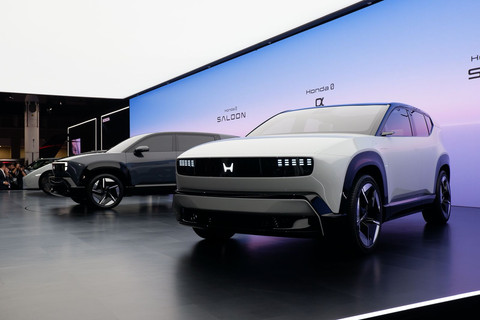

Honda Motor Corporation has issued an official statement announcing the cessation of its electric vehicle project. This significant decision also impacts plans for specific Battery Electric Vehicle (BEV) models slated for production in North America, marking a substantial shift in the automaker’s global strategy.
According to the company’s press release, this pivotal decision stems from a recent comprehensive review of Honda’s electrification strategy. A key contributing factor cited was the recent adjustments and restructuring within the manufacturer’s internal framework, prompting a reevaluation of its future direction.
The models at the heart of this cancellation were the much-anticipated realizations of the Zero Series prototypes, specifically the 0 Saloon and 0 SUV, which had been unveiled to the public some years prior. Honda is set to calculate the full extent of the financial losses incurred from the abandoned project by the end of March.
This strategic reversal inevitably casts a shadow over the automaker’s ambitious carbon neutrality projection, which targets achievement by 2050. The venerable Japanese brand openly acknowledged that it has fallen into an “extremely challenging revenue situation,” attributed to a confluence of various complex factors.

“Including its inability to flexibly respond to changes in this business environment, exacerbated by declining profitability of gasoline and hybrid models due0due to the impact of newly imposed tariffs,” detailed an official statement from Honda Global, highlighting the profound challenges faced by the company.
The repercussions of this decision are staggering, with Honda facing an estimated loss of up to 2.5 trillion yen, or approximately Rp 265 trillion. As a direct consequence, three distinct BEV models that had been meticulously prepared for production and market launch in North America will now be shelved.
“To rectify the current revenue situation as quickly as possible, Honda considered various options. After careful consideration, the company decided to cancel the development and launch of three BEV models planned for production in the United States, namely the Honda 0 SUV, Honda 0 Saloon, and Acura RSX,” Honda further elaborated, explicitly naming the affected models.
This development unfolds against a backdrop of rapidly shifting dynamics in the global automotive competition landscape. In the United States market, for instance, the growth of the BEV sector has shown signs of deceleration, influenced by the easing of fossil fuel regulations and changes in incentive policies for purely electric vehicles.

Concurrently, in China, another colossal automotive market, consumer preferences are undergoing a profound evolution. While historically focused on factors like fuel efficiency and cabin space, consumers are now increasingly prioritizing vehicles rich in digital-based features, signaling a new era of automotive demand.
Moving forward, the Japanese automotive giant will now strategically pivot its focus towards developing new energy technologies, particularly hybrid systems and more efficient internal combustion engines, leveraging its existing resources. This reorientation comes as the company works to finalize its estimated fiscal burdens.
Honda anticipates recording an operational burden ranging from 820 billion yen to 1.12 trillion yen (Rp 123-168 trillion) and an investment loss, recorded using the equity method, between 110 billion yen and 150 billion yen (Rp 16.5-18.5 trillion).
Furthermore, Honda projects a special loss of 340 billion to 570 billion yen in its non-consolidated financial statements for the same fiscal year. These figures are currently provisional and will be conclusively finalized in the consolidated and non-consolidated financial statements for the fiscal year concluding on March 31, 2026.
