
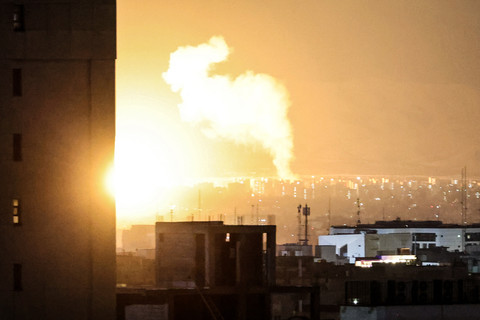
Twenty-two Indonesian citizens recently returned to their homeland on Tuesday, March 10th, providing firsthand accounts of the harrowing conditions they endured in Iran. Upon their arrival at Soekarno-Hatta International Airport, their stories painted a vivid picture of the escalating tensions in the region.
One of the returning citizens, 69-year-old Zulfan, described a particularly tense situation while at the Embassy of the Republic of Indonesia (KBRI) in Tehran, where they were processing their repatriation. He recounted how approximately ten bombs flew directly over the embassy building, causing the windows to visibly vibrate. “The situation was terrifying when we were at the Indonesian Embassy in Tehran; ten bombs passed overhead. And from one to two kilometers away, the sound of those bombs was extraordinary, making the embassy windows shake,” Zulfan stated. In response to the immediate danger, Zulfan mentioned that the Indonesian citizens attempted to move to the basement for safety, though the Ambassador of the Republic of Indonesia to Iran, Rolliansyah Soemirat, advised them against it for the time being.
Another Indonesian citizen, 26-year-old Jawad, corroborated the volatile atmosphere. He recounted hearing loud explosions at the KBRI on Friday, March 6th, around 6 AM, just as they were preparing to depart. Jawad explained that after confirmation, these sounds were identified as Iran’s air defense systems actively repelling alleged attacks from the United States and Israel.
Purkon Hidayat, an Indonesian lecturer at the University of Tehran, offered a similar account of the unsettling sounds. He detailed hearing a massive explosion at 5:30 AM during the Ambassador’s briefing. According to Purkon, this was a missile attack, and despite the considerable distance from the embassy, the sound was incredibly close and profoundly loud.
Purkon further elaborated on the expanding scale of the conflict, noting that fuel depots across Iran were also under attack. He revealed that approximately 20 fuel depots around Tehran were targeted, indicating a significant widening of the strikes beyond specific military installations.
The impact of these attacks on the environment and the city itself was severe, Purkon noted. Monitoring local Iranian media, he observed that the explosions caused Tehran to be plunged into darkness, and the day of the attack even brought acid rain to the city. From his residence in Tehran, Purkon claimed he could clearly see missiles flying overhead and detonating, underscoring the direct and pervasive nature of the conflict.
The most severe missile explosions, Purkon recalled, occurred during the initial major assault on Iran on Saturday, February 28th. These blasts were continuous and specifically targeted Iranian leadership. Being not far from the campus where he taught, Purkon witnessed the immediate aftermath: students were asked to evacuate their classes, and all university activities were suspended indefinitely. Purkon expressed grave concerns that the alleged US-Israel attacks on Iran had begun targeting civilian areas. He cited the recent attacks on fuel depots and, even more alarmingly, a girls’ school in a border area outside Tehran, which was bombed twice consecutively, resulting in 165 casualties in a single incident. This, he emphasized, signals a significant broadening of the conflict beyond military objectives to include civilian infrastructure.
Given the deteriorating security situation, Purkon confessed that he finds it exceedingly difficult to consider returning to Iran, especially in the near future. He affirmed that his family would certainly not be returning, and he is coordinating with university leadership to potentially shift all teaching and learning activities online for the foreseeable future.
