
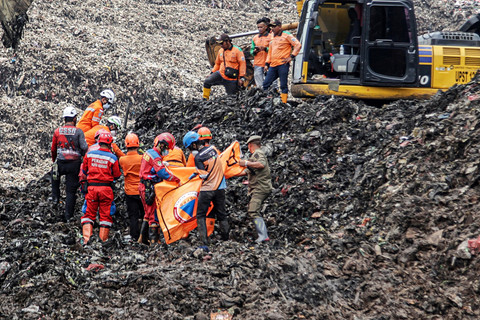
Joint search and rescue (SAR) teams are intensifying their efforts to locate victims following a tragic landfill landslide at the Bantargebang Integrated Waste Treatment Plant (TPST) in Bekasi, West Java. The critical operation continued on Monday, March 9th, as responders navigated the treacherous terrain of collapsed waste.
According to reports from Antara and data released by Basarnas DKI Jakarta as of Monday afternoon, the Bantargebang disaster has resulted in a grim toll of five fatalities. Additionally, four individuals remain unaccounted for and are actively being sought amidst the debris.
The arduous search for survivors and victims is being significantly aided by the deployment of heavy equipment. These crucial machines are systematically clearing the massive piles of compacted waste, which pose considerable challenges to recovery efforts and impede access to potential buried individuals.
The devastating collapse of the waste mound, specifically in Zone 4A of the Bantargebang TPST, struck on Sunday, March 8th, at approximately 2:30 PM Western Indonesian Time. Preliminary investigations suggest that the landfill landslide was likely precipitated by a combination of extreme, prolonged rainfall and the Ciketing River’s flow being significantly obstructed by accumulated refuse, contributing to the instability of the vast waste pile.
Summary
Joint search and rescue teams are intensifying efforts to locate victims following a tragic landfill landslide at the Bantargebang Integrated Waste Treatment Plant (TPST) in Bekasi, West Java. The disaster, which occurred on Sunday, March 8th, at approximately 2:30 PM Western Indonesian Time in Zone 4A, has resulted in five confirmed fatalities. Four individuals remain unaccounted for and are actively being sought amidst the debris.
The critical operation continued on Monday, March 9th, with heavy equipment significantly aiding the arduous search for survivors and victims by clearing massive piles of waste. Preliminary investigations suggest the collapse was likely precipitated by a combination of extreme, prolonged rainfall and the Ciketing River’s flow being obstructed by accumulated refuse, contributing to the waste pile’s instability.
