
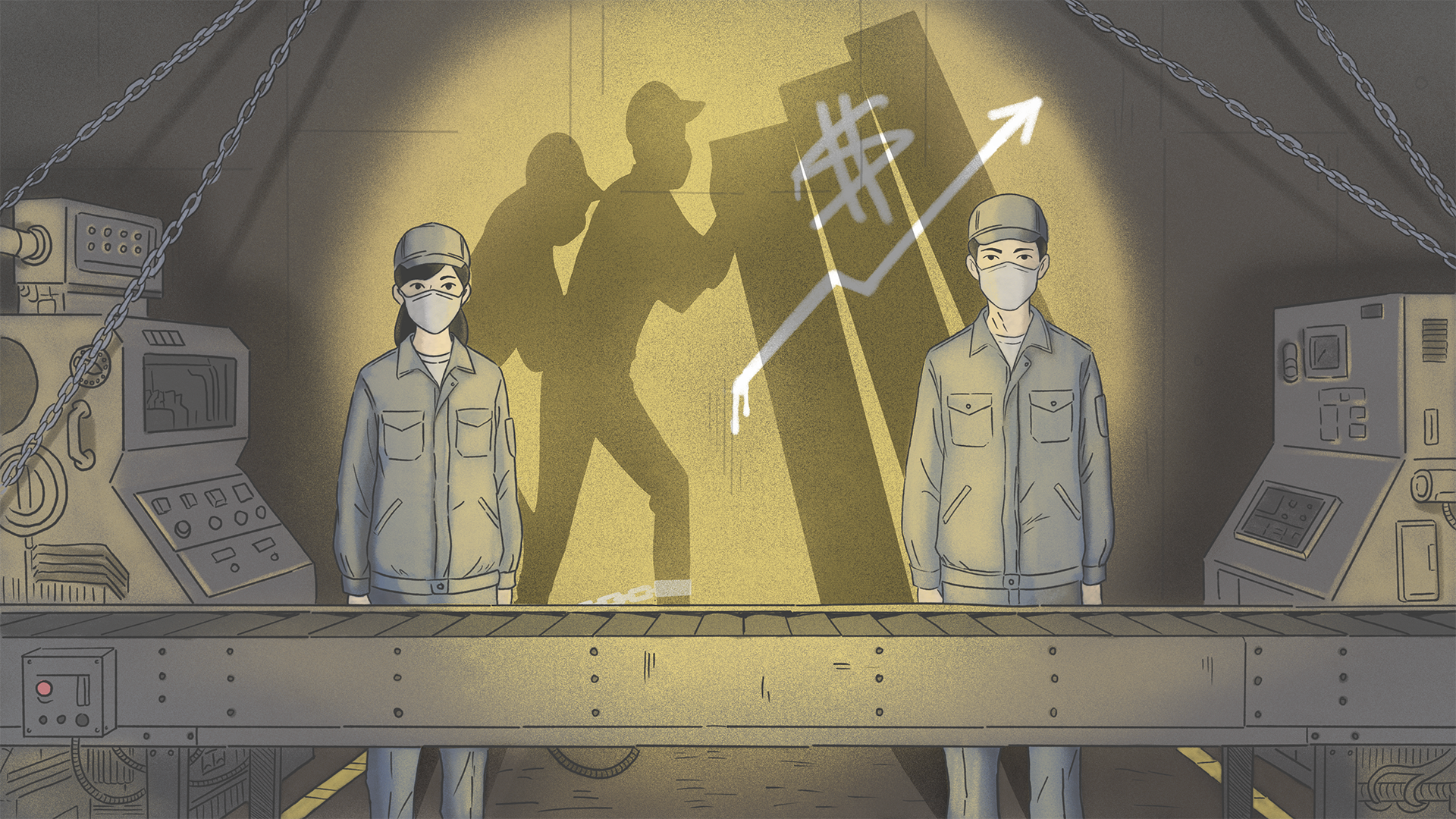

Amu (not her real name) bears a 15-centimeter scar on her right ankle, a stark reminder of her second year working in Taiwan. This injury, a broken leg sustained when her limb got caught in machinery during a workplace accident, marked a pivotal and terrifying moment in her life.
“I was incredibly scared at that time,” she recounted to BBC Chinese. Her nights were sleepless, not from physical pain, but from the paralyzing fear of losing her job and being overwhelmed by insurmountable debt.
Now 32, Amu journeyed to Taiwan seven years ago from Central Java, Indonesia, driven by the hope of earning enough to support her family back home. Like hundreds of thousands of other migrant workers, she had to borrow heavily to cover exorbitant agency fees. For more than a year, most of her meager salary was consumed by these repayments.
Her first job was at a small metal component factory in central Taiwan, where she operated heavy metal pressing machines for nine hours a day. Her monthly income amounted to Taiwan’s minimum wage, NT$23,000 (approximately Rp12.3 million).

For Amu, debt represented her greatest fear. She paid agency fees totaling NT$95,800 (Rp51.3 million)—an amount equivalent to roughly four months of Taiwan’s minimum wage. While Taiwan’s basic wage is six times that of Indonesia, deductions for labor contributions, health insurance, dormitory fees, remittances to family, and daily living expenses meant that almost her entire salary was swallowed by debt repayments.
In early 2021, following her accident, Amu underwent two surgeries on her right leg. Unable to work, her employer attempted to terminate her contract and refused to cover her medical expenses or wages during her recovery. Without the means to pay for proper medical facilities, Amu was left to recuperate in the factory dormitory, surviving on instant noodles.
Driven by the desperate need to keep her job, Amu returned to work a mere six months after her operation, despite her right leg still feeling numb, frequently experiencing shooting pains, and her inability to stand for extended periods.
“I have to keep working. Illness can heal, but debt will never heal,” she declared with a poignant resignation.
Forced Labor
Amu’s harrowing experience tragically mirrors the pervasive vulnerabilities faced by migrant workers across Taiwan. Many find themselves ensnared in cycles of debt that ultimately push them into situations internationally defined as “forced labor.”
Taiwan began recruiting migrant workers in the 1980s, and their numbers have now swelled to approximately 850,000, predominantly from Indonesia, the Philippines, Thailand, and Vietnam. This recruitment system has long relied on transnational agency networks, yet the opaque nature of fees consistently traps workers in deep debt.
Chen Hsiu-lien, Chairperson of the Taiwan International Workers’ Association (TIWA), explained to BBC Chinese that the core issue for these migrants isn’t that they are “involuntarily” forced to work, but rather that their conditions are “semi-voluntary.” While they formally “choose” to come to Taiwan, they are in reality bound by overwhelming debt within a system that compels them to accept excessive overtime, document retention, wage deductions or withholdings, substandard dormitory facilities, and verbal intimidation or pressure from management.

These human rights violations have garnered significant international scrutiny. In September 2025, the United States imposed a Withhold Release Order (WRO) on Giant, a prominent Taiwanese bicycle brand, citing risks of “forced labor” within its supply chain. This encompassed allegations of employees forced to work due to debt bondage, harsh working and living conditions, and companies exploiting the inherent vulnerabilities of migrant workers.
The news of the WRO caused Giant’s stock price to plummet. (Note: A WRO is an order prohibiting products from entering the U.S. during an ongoing investigation.)
Labor recruitment agency operators contend that Taiwanese authorities still permit agents to levy service fees on migrant workers. Consequently, even if a company’s recruitment procedures comply with “Taiwanese law,” international standards may still deem its supply chain problematic if it involves high broker fees charged to workers.
The International Labour Organization (ILO) identifies 11 indicators of forced labor, including poor working and living conditions, excessive overtime, delayed or deducted wages, intimidation, threats, physical or sexual violence, debt bondage, and restrictions on freedom of movement.
Jennifer Gordon, a professor at Fordham University School of Law in the U.S., informed BBC Chinese that any industry in Taiwan considered “low-wage” by local standards, reliant on migrant workers holding “tied visas,” and requiring workers to pay their own recruitment fees, faces an “extremely high risk of forced labor.” (Note: A tied visa links a worker’s legal status to a single employer, severely restricting their mobility.)
Exorbitant Brokerage Fees
Dika (not his real name), a 29-year-old worker from East Java, arrived in Taiwan just last year. Yet, barely a year into his journey, he is already plagued by regret.
“I often think about escaping, but there’s nowhere to run,” he lamented, describing the suffocating grip of debt that burdens him.
Before his departure for Taiwan, Dika borrowed nearly NT$140,000 (Rp75 million) from family and friends to pay agency fees, which he settled in three cash installments. Concurrently, he signed a “labor loan” agreement for NT$75,000 (Rp93.8 million). This effectively ballooned his total financial burden to over NT$210,000 (Rp112.5 million).
While the Indonesian government has stipulated an upper limit for placement fees at approximately NT$45,000 (Rp24.1 million), the reality on the ground often diverges dramatically. Migrant workers frequently remain unaware of precisely what they are paying for. Dika stated he never received any written documentation, only verbal explanations.
“They said it was money paid to the Indonesian government on my behalf, divided into seven installments, with monthly payments exceeding NT$10,000. If I didn’t pay, I would receive a court summons,” he explained. Each payday, his first task was to visit a convenience store to settle his installment.
“The amount is huge, but those are the rules—if you don’t pay, you don’t get the job opportunity. I’ve only just finished paying off that debt; I haven’t even really started earning money yet.”
Under Taiwanese regulations, agent service fees charged to migrant workers are strictly capped: a maximum of NT$1,800 (Rp964,800), NT$1,700 (Rp911,200), and NT$1,500 (Rp804,000) per month for the first three years, respectively. Charging excessive fees, demanding “job-buying money,” or direct wage deductions are illegal. However, the high fees collected by agents in workers’ home countries remain an open secret.
Various investigations indicate that the scale of these fees varies by nationality. Vietnamese workers typically face the highest charges, often exceeding NT$180,000 (Rp96.4 million); Indonesian workers generally pay around NT$80,000 (Rp42.8 million), which surged to NT$140,000 (Rp75 million) after the pandemic. For those unable to pay upfront, agents usually package the fees as wage deductions or collaborate with banks to provide loans, compelling workers to pay installments with interest after arriving in Taiwan. Filipino workers, in some cases, even have to pay interest almost equivalent to the fee itself.

Amu vividly recounted how her Vietnamese colleagues worked relentlessly to repay their agent debts. They reportedly slept only two hours a day and never ventured out on holidays; whenever their employer requested additional work, they immediately complied. Amu observed that they sustained themselves with medication and supplements to maintain their strength.
“They work like ghosts, just to send money home. I want to do the same, but my body can’t take it anymore,” she said, reflecting on her own declining health.
After her accident, Amu’s employment contract was not renewed. She had just managed to clear her debts and was finally preparing to save money, thus having no compelling reason to return home. However, her accident record made it incredibly difficult to secure a new job. She reached out to 15 different agencies before finally being accepted for another position.
Now, she works at a sandal factory under a piece-rate system, often laboring up to 15 hours a day with only two days off each month.
“If you work too slowly, your earnings aren’t enough. No one can stop; everyone has to keep doing overtime,” she explained, highlighting the constant pressure.
High-Risk Work Environments
Amidst Taiwan’s low birth rate and aging population, many high-intensity jobs are now primarily sustained by migrant workers. Currently, over 500,000 industrial migrant workers constitute the largest category of foreign labor, followed by domestic workers and caregivers. Industrial migrant workers are largely concentrated in the manufacturing sector, particularly in metal products and electronic components—environments inherently fraught with high risks. The disability rate resulting from workplace accidents in manufacturing for migrant workers is notably more than double that of local Taiwanese workers.
The Control Yuan, Taiwan’s government oversight body, even issued a reprimand to the Ministry of Labor, underscoring outdated factory equipment, language barriers, and inadequate safety training as critical factors contributing to the frequent workplace accidents among migrant laborers.
A Zong (not his real name), a 26-year-old Vietnamese worker, has spent seven years in Taiwan. At his previous factory, few young local workers remained; many Taiwanese employees were aged between 60 and 70. “Actually, this work depends on us. If we don’t do it, they can’t either. But we are never appreciated,” he confided to BBC Chinese.
Throughout his years at the same factory, A Zong never received a single pay raise. He was also barred from participating in company excursions or year-end dinners, events that local Taiwanese workers were permitted to attend. Upon his initial arrival in Taiwan, his colleagues warned him that if his performance was unsatisfactory, he could face deportation. In Taiwan, if a migrant worker is deemed “unsuitable,” an employer can unilaterally terminate their contract. Should the worker then fail to secure new employment, deportation becomes the inevitable consequence.
Having paid nearly NT$200,000 (Rp107.2 million) in agency fees, the immense pressure of debt compelled him to work harder and fear making even the slightest mistake. Even when he suffered a work accident two years ago—where a careless lift operator severed one of his fingers—he dared not complain. The company merely covered his medical expenses and provided time off. His labor insurance compensation amounted to approximately NT$100,000 (Rp53.6 million).
“The factory wasn’t safe. New, inexperienced workers were very easily injured, but we came to Taiwan to earn money and work hard. As long as the company isn’t too bad and can be tolerated, we don’t want to make an issue of anything.” One of his friends in Taiwan lost three fingers in a work accident and received only NT$100,000 (Rp53.6 million) in compensation. Afterward, the company and agent sent him back to Vietnam. “We were angry, but didn’t know how to help—so we could only try to find another company for him.”
Debt Upon Debt
In Taiwan, the employment contracts between migrant workers and employers typically span three years. Only after this contract period concludes are they considered “free to move” to other jobs. During the contract term, workers can only apply for a transfer through the Ministry of Labor with the employer’s explicit consent, or under specific circumstances such as the employer’s death, business closure, or a labor dispute not initiated by the migrant worker.
Chen Hsiu-lien, Chairperson of TIWA, explained that this rigid system prevents migrant workers in Taiwan from freely changing jobs, particularly after sustaining injuries or experiencing labor disputes. Migrant workers often lack institutional protection or support from agents. The vast majority also possess limited legal knowledge and face significant difficulties in submitting evidence to support their claims.
Even if a migrant worker successfully obtains permission to transfer, “job opportunities remain controlled by agents,” and workers are frequently forced to pay “job-buying money” to secure a new position, thus trapping them once again in a relentless cycle of debt. In 2025 (likely 2023 or 2024 given the context), the Ministry of Labor arrested 10 agency firms that were illegally charging “job-buying money” to migrant workers seeking to transfer employers.
Dido (not his real name), a 41-year-old Indonesian migrant worker, is one such victim. He has been in Taiwan for nearly 10 years and has changed jobs four times. Each time he switched employers, agents charged him fees ranging from NT$35,000 (Rp18.7 million) to NT$65,000 (Rp34.8 million).
“Initially, I didn’t want to pay, but then I realized if I didn’t, I couldn’t get a job. So I was forced to pay to start working quickly,” he recounted. Dido came to Taiwan after getting married, hoping to provide a better life for his family. He paid nearly NT$200,000 (Rp107.2 million) for agency fees—including airfare, documents, accommodation, and training—forcing him to borrow extensively from various sources. The additional “job-buying money” further exacerbated his debt pressure. He acknowledged that as he ages, his options are dwindling: “Whether the job is good or bad, I still want to take it.”
According to agent Hsu Chia-chun, most employers delegate recruitment quota arrangements to agents due to complex legal procedures. Once a worker’s contract is terminated, it is the agent who determines whether to “take over a worker already in Taiwan” or “recruit new workers from overseas.” “Because recruiting from overseas yields greater profit, agents often persuade employers to choose new workers from abroad—making it increasingly difficult for workers already in Taiwan to transfer employers,” she stated.
However, she added that this situation is beginning to shift. As several industries in Taiwan start to adopt a “zero-fee policy” for migrant workers, employers seeking to recruit from overseas must now bear broker fees of NT$30,000–NT$50,000 (Rp16 million-Rp26.8 million). Conversely, taking over a worker already in Taiwan incurs no additional cost.
‘Zero-Fee’ Policy for Migrants
To prevent migrant workers from falling into debt bondage and the risks of forced labor, the International Labour Organization (ILO) and various conventions, particularly those related to the fisheries sector, emphatically uphold the principle that “recruitment costs must be borne by the employer”—a concept widely known as the “zero fees for migrants” principle.
Since 2019, Taiwan’s electronics industry, spurred by pressure from the Responsible Business Alliance (RBA), the world’s largest association of electronics brands, became the first sector to implement the “zero fees for migrants” principle. Technology giants such as TSMC, Acer, and Delta Electronics now mandate that their partner agents do not charge migrant workers any fees, with all costs fully absorbed by the employer.
The United States stands among the few nations actively enforcing import prohibitions related to forced labor. Under Section 307 of the Tariff Act of 1930, U.S. Customs and Border Protection (CBP) can bar such goods from entering the U.S. and issue a withhold release order based on “reasonable suspicion” that an item involves forced labor. If deemed necessary, the agency can impose fines or demand additional documentation from companies.

Academic Jennifer Gordon clarified that the payment of recruitment fees does not automatically constitute forced labor. If workers are still able to cover these costs through decent wages—for instance, high-income professionals who can meet their living expenses even after paying recruitment fees—then that situation is not classified as forced labor. “However, if the fees are so high they exceed the worker’s ability, trapping them in debt and making them unable to escape the control of the employer or agent, then it falls within the definition of forced labor.” She underscored that when debt bondage intertwines with a visa system that restricts mobility, this combination becomes a primary factor creating forced labor conditions.
Following the withhold release order issued by the U.S. government last year (referencing the 2023 WRO), Taiwanese bicycle companies Giant and Merida promptly initiated corrective measures. On January 1, 2025 (as per original text), Giant announced a new policy: for all newly recruited migrant workers, the company would fully cover agent fees, service fees, and all related regulatory costs. After being cited by U.S. CBP, Giant even expanded this policy by reimbursing all fees previously paid by existing migrant workers. Merida subsequently followed suit, fully implementing a “zero-fee policy” and reimbursing all agent fees that had been paid by its current migrant workers.
Struggling Industries
Currently, Giant’s products remain under the U.S. CBP’s withhold release order and have not yet been cleared. This sanction starkly highlights the pervasive issue of forced labor in Taiwan and serves as a critical warning for Taiwan’s manufacturing sector, which employs over 400,000 migrant workers.
The Chinese National Federation of Industries (CNFI) in Taiwan has articulated in various forums that as supply chain oversight becomes the new standard in Europe and the United States, industrial players are deeply concerned about the ripple effects. They argue that the government must urgently adjust migrant labor regulations to align with international standards.
Lin Mei-ju, head of the Meijia Manpower agency, explained to BBC Chinese that it is not easy to compel all Taiwanese companies to adopt the “zero-fee policy” championed by large electronics firms. Taiwan’s manufacturing industry is predominantly composed of small and medium-sized enterprises (SMEs), whose capital capacity and profit margins are significantly lower than those of electronics giants or major bicycle manufacturers. “If all agent fees suddenly have to be borne by employers, that will become a huge burden,” Lin stated.
She added that the “zero-fee policy” also encounters resistance from agents. Some exaggerate costs, leading employers to mistakenly believe that meeting ILO standards for each migrant worker recruitment would cost over NT$200,000 (Rp107.2 million), causing many companies to hesitate. Lin noted that she has clients who have successfully implemented the “zero-fee policy”: migrant workers only need to cover the costs of departure documents and airfare, while the employer pays agent fees equivalent to approximately one month’s minimum wage (slightly over NT$20,000), which already satisfies international supply chain compliance requirements. “The problem is, many employers don’t know the actual costs.”
Lin observed that recently, many companies in central and southern Taiwan are experiencing a business downturn due to the impacts of Taiwan-U.S. tariffs. In advocating for the “zero-fee policy” or other improvements, she cautioned that if the advocacy is not handled carefully, the issue could escalate into tension between Taiwanese citizens and migrant workers. She believes the government needs to clarify industrial conditions more effectively and offer incentives—such as increased migrant worker quotas or industry assistance—to facilitate gradual reform. Given that current company recruitment procedures are “in accordance with Taiwanese law,” the Giant case is not an exception—any company could potentially face product detention by U.S. CBP if its supply chain involves high agent fees for migrant workers. Lin suggested that since fees in workers’ home countries are regulated by their respective laws, reforms could commence on Taiwan’s side, for example, by abolishing regulations that permit agents to collect monthly service fees from migrant workers.
Urgent Legal Revisions
Over half of Taiwan’s jobs are directly linked to global supply chains. If the conditions of migrant workers remain unreformed, the repercussions will directly impact the domestic economy. On February 13, Taiwan and the United States officially signed the Taiwan–U.S. Reciprocal Trade Agreement, which notably includes requirements for Taiwan to align with international labor standards.
Taiwan’s Ministry of Labor announced plans to revise laws to prohibit the retention of workers’ identity documents and, within three years, implement a ban on recruitment fees for migrant workers in the manufacturing and fisheries sectors. Minister of Labor Hung Shen-han confirmed to BBC Chinese that the government intends to amend legislation within three years to overhaul the migrant recruitment system and forbid the collection of recruitment fees from migrant workers in manufacturing and fisheries.
He emphasized that the human rights of migrants must meet contemporary standards and should not be shackled by debt. As global brands increasingly demand labor protection within international supply chains, several Taiwanese industries have received notices to implement reforms, and national regulations must align with global benchmarks. “We must pay more attention to the issue of forced labor and improve the recruitment model that has been in place for decades,” Hung asserted. He also disclosed that before the legislative revisions are finalized, the government will promote various reforms and assistance programs.
The Ministry of Labor has already issued guidelines on forced labor and is actively discussing further plans with the Ministry of Economic Affairs. Agent assessments will incorporate indicators for forced labor prevention; the practice of agents retaining workers’ documents will be explicitly prohibited through legislative changes. Furthermore, the ministry is reviewing the government’s direct recruitment system to streamline procedures, aiming to encourage employers to recruit migrants without intermediary agencies.

Associate Professor Chiu Yufan from the Faculty of Law and Technology, National Yang Ming Chiao Tung University, stated that Taiwan’s rules, which still permit agents to charge service fees to migrant workers, are clearly out of step with international trends and ought to be abolished. “No one opposes agents charging fees, but the fee standards must be reasonable and should not be borne by migrant workers, as these are labor costs that should be shouldered by the employer.”
Chiu emphasized that beyond pressure from the U.S. government, the European Union is set to implement its Regulation on Prohibiting Products Made with Forced Labour starting in 2027. This regulation will forbid products involving forced labor from being sold or circulated in the European market. Consequently, Taiwanese companies must establish transparent and compliant monitoring mechanisms or risk losing orders from Europe.
Academic Jennifer Gordon remarked that predicting whether the next U.S. withhold release order will target other Taiwanese manufacturers is “completely uncertain.” However, should manufacturers be concerned? “Yes—as long as workers are in conditions meeting the definition of forced labor, they should indeed worry. Because we must abolish forced labor entirely.” Gordon identified two core pillars for Taiwan’s reform: first, enabling migrant workers to freely change jobs according to visa provisions; second, ensuring that recruitment costs are borne by the employer. Additionally, migrant workers should receive wages and labor protections equivalent to local workers and possess the right to join unions or other organizations.
Hsu Chia-chun, a labor agent, suggested that if Taiwan aligns its policies with international standards and fully implements a “zero-fee policy,” traditional labor-intensive industries will be compelled to undergo transformation. Historically, employing migrant workers represented a relatively low cost for companies. However, if employers are mandated to bear agent service fees in the future, operational costs will increase, and companies will likely reduce their reliance on migrant labor. “There will be an effect where prices are regulated by reduced volume, pushing companies to review their labor models and accelerate the adoption of automation, AI, and robotics,” she projected.
Long-term Position of Migrant Workers
Professor Lan Pei-chia from the Department of Sociology, National Taiwan University, noted that the international labor market has also been evolving in recent years. Migrant workers now possess a broader array of choices—not solely Taiwan, but also Japan, South Korea, Hong Kong, and Singapore. The new generation of migrant workers exhibits a stronger awareness of their rights and is more adept at leveraging technology to seek information and protect themselves.
She stressed that for Taiwanese employers to attract and retain migrants, they must significantly improve working conditions. With a low birth rate and a chronic labor shortage, Taiwan also needs to strategically consider how to build a stable and skilled workforce, enabling migrants to stay long-term—potentially even becoming future immigrants. Currently, the maximum working duration for industrial migrant workers in Taiwan is 12 years. Although the government has proposed a program allowing experienced migrant workers to be exempt from this time limit under certain conditions, its implementation remains severely limited.
Amu, the Indonesian worker, still has four more years left on her eligibility to work in Taiwan. However, she remains pessimistic about extending her stay. Her employer has explicitly stated that her contract cannot be renewed, leaving her with no option but to strive to accumulate as much money as possible before her work permit expires. Last year, she managed to save a small amount and got married, but life’s pressures have not abated: “The foundation of our house back in the village has only just been completed,” she shared, her voice tinged with the weight of unfulfilled dreams.
A Zong, the Vietnamese worker, returned home last year after concluding that working in Taiwan no longer offered him hope. His previous factory consistently treated him as the cheapest labor source, while rigid regulations made it difficult for him to transfer to another factory with better working conditions. Now, A Zong is preparing to apply to a university in Taiwan. During his time in Taiwan, he diligently learned Mandarin and successfully saved money. He shared that pursuing higher education is a long-cherished dream. “We came to Taiwan—some are lucky, some aren’t. Perhaps I am still among the lucky ones, right?” he mused, a flicker of hope amidst his past struggles.
Summary
Many migrant workers in Taiwan, exemplified by Amu’s severe workplace injury and overwhelming debt from exorbitant agency fees, are trapped in conditions internationally defined as “forced labor.” They face immense financial burdens, restricted job mobility through “tied visas,” and often work in high-risk environments, compelling them to endure exploitation to repay debts. Amu’s poignant reflection, “Illness can heal, but debt will never heal,” underscores their predicament.
This systemic issue has attracted significant international attention, including a US import ban on products from a Taiwanese company due to forced labor risks. In response, Taiwan’s Ministry of Labor plans to revise laws within three years to prohibit recruitment fees for migrant workers in manufacturing and fisheries sectors, and to ban the retention of identity documents. These reforms aim to align Taiwan’s labor practices with international standards and dismantle debt bondage within its critical supply chains.
