
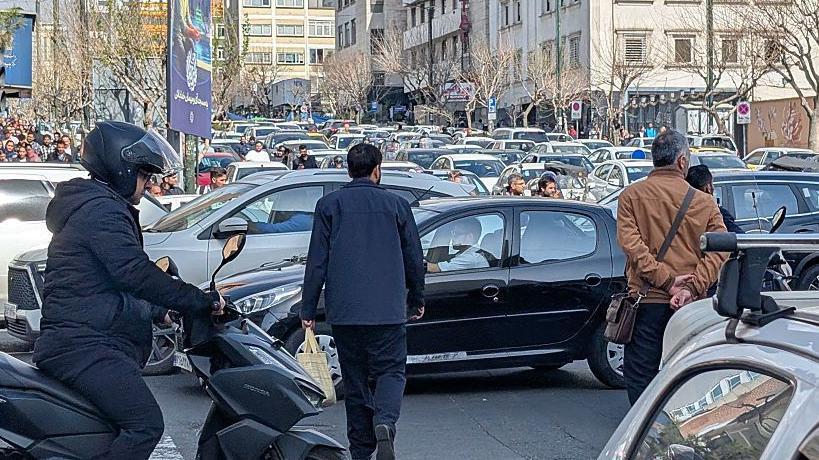
On Saturday morning, February 28, at approximately 09:40 local time, residents across several Iranian cities reported hearing a series of thunderous explosions.
Immediately, disturbing videos circulated on social media, depicting people near the blast sites fleeing in utter panic amidst a cacophony of screams and cries.
Yet, amidst the chaos, a paradoxical sense of relief swept through parts of the population. Many held a firm conviction, as reported by BBC Persia, that the downfall of the Iranian government could only be achieved through direct military intervention.
The following morning, Iranians awoke to earth-shattering news: Supreme Leader Ali Khamenei had reportedly been killed in a joint US and Israeli airstrike launched overnight.
The announcement of his death first came from US President Donald Trump, quickly followed by Iranian state media confirming the demise of the figure who had governed Iran for over 36 years.
“I can’t believe it. This is such overwhelmingly good news, I don’t know what to do,” a resident in the capital city of Tehran jubilantly told BBC Persia.
They added, “I couldn’t sleep all night; I was just waiting to begin the first day without Khamenei. I believe the Middle East has become a better place. The entire world, in fact, is better for it now.”

Numerous other Iranian citizens echoed similar sentiments of elation. One viral video captured a woman openly expressing her profound relief following reports that Khamenei’s residence had collapsed under the force of the airstrikes.
Another compelling clip showcased teenagers at a school exuberantly dancing and singing, seemingly in celebration of the attacks, with chants of “I love Trump” audible in the background.
Many had, in fact, anticipated the possibility of such US military intervention. Since Friday evening, February 27, long queues had snaked around petrol stations, and residents of the capital, Tehran, began evacuating the city, heading north towards the Caspian Sea, a region widely believed to be safer.
As the attacks commenced, Iran plunged into an almost complete internet blackout, rendering communication with anyone within the country exceedingly difficult.
Nevertheless, a determined few managed to bypass the restrictions, accessing the internet through methods such as SpaceX’s Starlink satellites and Virtual Private Networks (VPNs).
The BBC successfully managed to reach several pro-government figures, who offered their perspectives on the unfolding situation in Tehran.
“We heard many explosions. I live in central Tehran,” one individual reported to BBC Newshour.
“It was initially a normal day until the United States and Israel began their assault on the city. Our children had gone to school that morning, and we had to rush to collect them,” they recounted.
Another resident, speaking to the BBC Weekend program from their office in northern Tehran, described hearing fighter jets and two distinct explosions on Saturday morning, February 28. The atmosphere was palpable with tension, and there was widespread apprehension that an air war was imminent.
They also noted a surge in panic buying, with numerous citizens rushing to stock up on canned goods and other essentials.
Via Starlink, another individual informed BBC Persia of stringent security measures in place on the roads leading to the government’s high-ranking officials’ complex, which had previously served as Khamenei’s offices.
‘Take Care of Our Children’
Prior to the widespread power outages and complete internet collapse, some individuals had managed to post poignant messages on social media – effectively their last wills and testaments – anticipating their potential demise in the airstrikes.
“If I die, do not forget that we existed. We who opposed any military attack, we who will become mere numbers in the casualty reports,” one Iranian citizen tragically wrote on social media.
Another netizen condemned: “Damn the dictatorial regime that ignited this war. We have already endured three wars.”
Several posts underscored the profound communication difficulties and the overwhelming anxiety for children caught in the escalating conflict.
“The internet is almost dead. If the network truly collapses, know that we are not soldiers for any leader, nor are we mere collateral damage,” another netizen passionately declared.
“We are human beings with the right to live. Strive for our future to be democratic, not dependent on any single individual.”
A particularly poignant plea from another social media user read: “Promise that if anything happens to us, you will care for our children and please treat them with utmost kindness. Tell them we did everything we possibly could. We participated in silent demonstrations, we voted, we worked double shifts, we endured immense suffering.”
According to BBC Persia, many Iranians, having endured some of the bloodiest repression of civilians in modern history under the existing regime, now openly welcomed regime change. This was true even if it meant achieving it through military intervention and the assassination of high-ranking officials.
Conversely, other citizens expressed deep concern that airstrikes alone might prove insufficient to truly topple the entrenched regime.
Their fear was that the regime could endure and, in retaliation, become even more brutal towards its own people.

During protests over a month prior, which resulted in thousands of deaths, then-President Donald Trump had encouraged Iranians to continue their demonstrations, promising that assistance would soon arrive.
Currently, some Iranian citizens reported receiving text messages proclaiming, “Help has come.” These messages urged people to remain indoors and called upon regime forces to lay down their weapons.
However, public sentiment remains volatile and could drastically shift, particularly if civilian casualties mount during these attacks.
This volatility was evident when many Iranians reacted with profound anger following state media reports of an Israeli attack on a girls’ school in Minab, southern Iran, which allegedly killed numerous individuals, including children. The BBC has, however, been unable to independently verify the reported death toll at the school.
Iranians living abroad who oppose military intervention in Iran voiced their outrage, stating: “The first victims of this war are 40 girls in Minab, hit by a missile. Is this the war you support?”
Nevertheless, a deep-seated distrust of the Iranian regime made official reports difficult for many to accept. Consequently, some Iranian citizens continued to squarely blame the regime for the attacks.
One social media user articulated this sentiment, writing: “Even if the regime did not directly target the school, the deaths of the children in Minab remain the undeniable responsibility of the Islamic Republic.”
They elaborated, “People have no shelters, the internet is cut off, phone lines are dead, and there was no warning for children not to attend school. Under these dire conditions, the minimum requirement should have been for everyone to stay at home.”
- Iran’s Supreme Leader, Ayatollah Ali Khamenei, Dies in US and Israeli Attacks
- Ayatollah Ali Khamenei Dies: Who is His Successor and What Happens Next?
- ‘This Isn’t the Dubai We Know’ – Accounts from Residents and Tourists as Iran Attacks UAE
- Israel Kills 31 in Lebanon as Conflict Spreads After Attacks on Iran
- Global Oil Prices Soar After Ships Attacked Near Strait of Hormuz
- President Prabowo Offers to Mediate US-Israel-Iran Conflict – ‘Highly Unrealistic’
- US-Iran Tensions: Tehran Might Choose Confrontation Over ‘Surrender’
- Israel and Hezbollah Exchange Missiles as Conflict Spreads After Attacks on Iran
- Iran’s Supreme Leader, Ayatollah Ali Khamenei, Dies in US and Israeli Attacks
- What is the Status of Iran’s Nuclear Program, and What Threats Might it Pose?
Summary
Pada 28 Februari pagi, sejumlah kota di Iran diguncang ledakan dahsyat, disusul kabar kematian Pemimpin Tertinggi Ali Khamenei akibat serangan udara gabungan AS dan Israel. Banyak warga Iran, yang frustrasi dengan pemerintah, menunjukkan kelegaan dan bahkan merayakan kabar tersebut, melihatnya sebagai jalan satu-satunya menuju perubahan rezim. Komunikasi terhambat karena pemadaman internet, meskipun beberapa berhasil mengaksesnya melalui Starlink dan VPN.
Namun, di tengah euforia, sebagian warga mengutuk perang, mengkhawatirkan korban sipil dan anak-anak. Sentimen publik menjadi tidak stabil setelah laporan yang belum terverifikasi mengenai serangan terhadap sebuah sekolah perempuan di Minab yang menewaskan banyak korban, termasuk anak-anak. Kejadian ini memicu kemarahan, dengan beberapa pihak menyalahkan rezim atas minimnya perlindungan dan infrastruktur, terlepas dari siapa pelaku penyerangan sekolah.
