
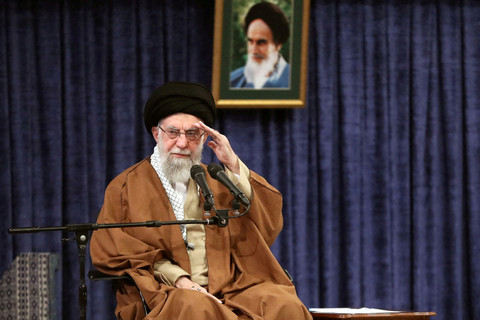

Discussions regarding Iran’s leadership succession mechanism have begun in earnest following the death of Supreme Leader Ayatollah Ali Khamenei, reportedly after significant attacks by the United States and Israel.
The critical task of determining Khamenei’s replacement now falls to the 88 members of the Assembly of Experts, who are set to convene for deliberations, as reported by Al-Jazeera on Sunday, March 1.
Two primary scenarios for this pivotal transition have emerged. The first suggests that prior to his demise, Khamenei had already prepared a list of four potential successors, though the Assembly of Experts has yet to disclose these names. The second scenario involves the formation of a four-person interim council, which would be tasked with overseeing government operations during the transitional period until a new leader is officially selected.
Notably, Khamenei had previously designated potential candidates to succeed him in the event of his death during a conflict with Israel.
According to a Reuters report from June 2025, a three-member committee drawn from a prominent clerical body, personally appointed by Khamenei to identify his successor, had significantly accelerated its planning. Five sources familiar with these internal discussions confirmed that Khamenei was routinely briefed on their progress. These sources indicated that, should Khamenei die, the ruling elite would move swiftly to appoint a successor, thereby affirming the nation’s stability and continuity of power.
One source revealed that a crucial criterion for the prospective new leader remains an unwavering loyalty to the fundamental principles of the Islamic Revolution, as established by the founder of the Islamic Republic of Iran, Ayatollah Ruhollah Khomeini. Within these sensitive internal discussions, two names have notably surfaced: Mojtaba Khamenei, the son of the late leader, and Hassan Khomeini, the grandson of Ayatollah Ruhollah Khomeini.
However, the sources underscored that no final decision has been reached, emphasizing that the list of candidates remains subject to change, with the ultimate choice resting with the highest authority.

Earlier, Iranian government sources had confirmed the death of Ali Khamenei, following what was described as massive attacks launched by the United States and Israel.
Al-Jazeera further reported that the Iran government has declared a 40-day period of national mourning for Khamenei. This confirmation was conveyed by Iranian news agencies Tasnim and Fars on Sunday, March 1. Fars indicated that the decision to observe mourning was made shortly after Khamenei’s death was officially announced to the public.
Adding to these reports, IRINN, via AFP, confirmed that Iranian state television announced the death of Iran’s Supreme Leader, Ayatollah Ali Khamenei, on Sunday, March 1.
A presenter on the state television delivered the solemn news of Khamenei’s passing around 5:00 AM local time.
“The great nation of Iran, the noble spirit of the Iranian people, and the great leader of Muslims, Imam Khamenei, has died a martyr in the holy month of Ramadan,” the presenter declared.
The presenter further added, “Today, the great nation of Iran, Muslims, and freedom fighters worldwide are mourning the malicious attack carried out by criminal United States and disloyal Zionists.”
Summary
Iran’s Supreme Leader Ayatollah Ali Khamenei has reportedly died following significant attacks by the United States and Israel. The Iranian government has confirmed his death and declared a 40-day period of national mourning, with state television announcing his passing on Sunday, March 1. The critical task of determining Khamenei’s replacement now falls to the 88 members of the Assembly of Experts.
Two primary scenarios for this leadership transition have emerged: either Khamenei had prepared a list of four potential successors, or an interim council will be formed. Prior to his demise, Khamenei had designated candidates in case of his death during a conflict, and a committee had accelerated succession planning. Discussions have seen Mojtaba Khamenei, the late leader’s son, and Hassan Khomeini, a grandson of Ayatollah Ruhollah Khomeini, surface as potential candidates, with unwavering loyalty to the Islamic Revolution being a crucial criterion.
