
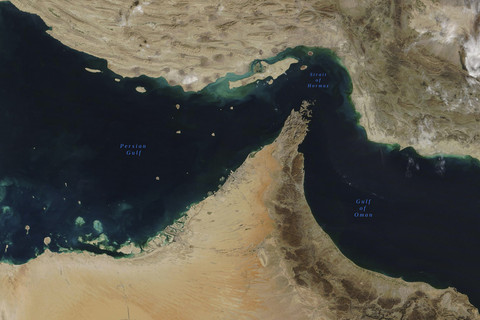

The Strait of Hormuz is globally recognized as a critical artery for international oil shipments. This strategic waterway has frequently been leveraged by Iran as a tool for geopolitical pressure, with repeated threats of closure surfacing whenever regional tensions escalate.
The latest surge in tensions followed an alleged attack on Iran by the United States and Israel on Saturday, February 28. This incident occurred just two days after delegations from Tehran and Washington concluded a third round of negotiations in Switzerland concerning Iran’s nuclear activities.
Earlier in January, a senior commander of Iran’s Revolutionary Guard Corps Navy reiterated the threat to close the strait should Iran face an attack. This warning came after former US President Donald Trump cautioned about potential military action if Iran failed to curb its nuclear program.
Despite these persistent threats of blockade, Tehran has never fully implemented one. However, the strait was partially closed temporarily during recent military exercises, with Iran citing safety concerns for the disruption.
Here are key insights into the Strait of Hormuz, as reported by AFP on Saturday, February 28:
The Gateway to the Gulf
Connecting the Persian Gulf to the Indian Ocean, the Strait of Hormuz is strategically positioned between Iran and Oman’s Musandam exclave, located at the tip of a peninsula. With a width of approximately 50 kilometers and shallow waters reaching a maximum depth of 60 meters, its inherent geographical features render it susceptible to military closure.
The strait is dotted with small, strategically significant islands, many of them sparsely populated or desert-like. Prominent among these are Iranian islands such as Hormuz, Qeshm, and Larak. The area also includes the disputed islands of Greater Tunb, Lesser Tunb, and Abu Musa, situated between the United Arab Emirates and Iran, which provide crucial vantage points over the Gulf. These islands have remained under Iranian control since 1971.
A Crucial Oil Transit Point
This vital corridor is indispensable for linking the oil-rich Gulf region with energy markets across Asia, Europe, North America, and other global destinations.
According to the US Energy Information Administration (EIA), the Strait of Hormuz stands as one of the world’s most critical chokepoints for oil transit. Roughly one-fifth of global crude oil and petroleum product consumption passed through the strait in 2024, averaging 20 million barrels per day. Furthermore, approximately one-fifth of the world’s liquefied natural gas (LNG) trade, predominantly from Qatar, also traversed the Strait of Hormuz in the same year.
While Saudi Arabia and the United Arab Emirates possess some infrastructure to bypass the strait, potentially mitigating disruptions, their transit capacity remains highly limited, estimated at around 2.6 million barrels per day.
The EIA underscores the strait’s unparalleled importance, stating, “Large volumes of oil flow through this strait, and there are very few alternative options to reroute oil shipments if the strait is closed.”
Data from analytics firm Kpler indicates that over 80 percent of the oil and gas transiting the strait is destined for Asian markets. Notably, China, a key ally of Tehran, procures more than 90 percent of Iran’s oil exports.
A Geopolitical Military Hotspot
Iran’s Revolutionary Guard Corps maintains naval control over operations in the Gulf and the Strait of Hormuz. Tehran has consistently voiced criticism regarding the presence of foreign military powers in the region, which hosts the US Fifth Fleet in Bahrain and the largest US military base in the Middle East, located in Qatar.
In 2023, Western naval forces operating in the Gulf issued warnings to vessels navigating the strait, advising them to avoid Iranian waters to minimize the risk of seizure.
A series of similar incidents have occurred since 2018, when former President Trump withdrew the US from the landmark nuclear agreement with Iran and reimposed stringent sanctions, leading to a sharp escalation in tensions.
Oil transit was significantly disrupted in 1984 during the Iran-Iraq War, a period famously known as the “Tanker War,” where both sides attacked opposing vessels, damaging or destroying over 500 ships.
Following Tehran’s mining of the strait, the USS Samuel B. Roberts frigate struck one of these mines in April 1988, nearly sinking. In July of the same year, Iran Air Flight 655, an Airbus A300 en route from Bandar Abbas to Dubai, was shot down by two missiles fired from a US frigate, killing all 290 people on board. The crew of the USS Vincennes claimed they mistakenly identified the civilian aircraft as a hostile Iranian fighter jet.
The Strait of Hormuz has also been a frequent site of vessel seizures and attacks, with incidents intensifying after the US withdrew from the international agreement on Iran’s nuclear program in 2018.
In 2019, a series of unclaimed attacks on vessels in the Gulf region, drone shoot-downs, and tanker seizures fueled concerns about a broader escalation between Tehran and Washington.
On July 29, 2021, an attack in the Gulf of Oman on a tanker operated by an Israeli billionaire’s company resulted in two fatalities. Israel, the United States, Britain, and Romania accused Tehran of responsibility, an accusation Iran vehemently denied.
Most recently, in April 2024, the Revolutionary Guard Corps seized the Portuguese-flagged container ship MSC Aries, alleging its owners had “ties to Israel.” Furthermore, in early February of the same year, a US-flagged tanker was approached and challenged by armed Iranian vessels in the strait before continuing its voyage, as confirmed by the US Central Command.
Summary
The Strait of Hormuz is a crucial international waterway for oil shipments, strategically positioned between Iran and Oman. Iran frequently threatens to close this strait, especially during heightened regional tensions, such as recent escalations following an alleged US-Israel attack on Iran and ongoing nuclear negotiations. Although Tehran has never fully implemented a complete blockade, partial closures have occurred during military exercises.
This strait is globally recognized as one of the most critical chokepoints for oil transit, handling approximately one-fifth of global crude oil and petroleum product consumption, with limited alternative routes. Historically, it has been a significant geopolitical hotspot, marked by incidents like the “Tanker War,” vessel seizures, and attacks, particularly intensifying after the US withdrew from the nuclear agreement with Iran in 2018.
