
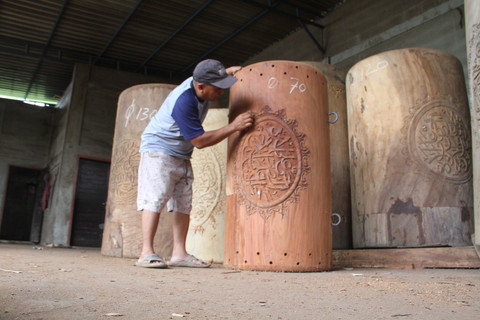

For Sugiarto, a seasoned artisan of traditional Indonesian drums, the spirit of Ramadan this year hasn’t translated into booming business. Instead, beduk sales at his workshop have been exceptionally sluggish, marking a significant downturn in a period usually bustling with activity.
Sugiarto, a 48-year-old beduk craftsman hailing from Kedungsari Village, Gebog District, Kudus Regency, Central Java, shared his concerns about a drastic decline in orders. This Ramadan, he has received only a single order for the large drums traditionally used to mark prayer times and festive occasions.
That solitary order for a beduk came all the way from Palembang. It was a smaller drum, measuring 60 centimeters in diameter and 1.2 meters in length, with a price tag of Rp 10 million (approximately $620 USD).
With 26 years dedicated to the intricate art of beduk making, Sugiarto is accustomed to a flurry of orders each Ramadan. However, this year stands in stark contrast to his past successes.
He recalled that in 2015, his workshop was vibrant with demand, securing between eight and ten beduk orders. The situation has taken a dramatic turn in recent years, with sales experiencing a sharp and continuous decline.
Last Ramadan, Sugiarto only managed to secure two beduk orders. This year, the numbers have shrunk even further, to just one order received so far during the holy month.
Beyond beduk, Sugiarto also crafts rebana, another traditional Indonesian musical instrument. mirroring the fate of his beduk sales, demand for rebana has also plummeted this Ramadan season.

Sugiarto accepts orders for both full rebana sets and individual instruments. A complete set, priced at Rp 2.5 million (approximately $155 USD), includes four rebana units, two keprak, one tam tung, one bas, and one darbuka.
“In 2015, I could sell hundreds of rebana sets. This Ramadan, it’s only 30 sets,” he stated on Friday, February 27, highlighting the severity of the drop in rebana sales.
Remarkably, before 2020, Sugiarto’s beduk and rebana creations garnered national attention, with orders pouring in from across Indonesia, extending from Java to other islands.
“This Ramadan, I tried marketing in Tuban, Kendal, Yogyakarta, Malang, Surabaya, and Cirebon. But the results were futile; no one was interested,” he lamented, underscoring the current economic challenges faced by his small business.
The lack of orders has had a profound impact on his workforce. Several employees have had to be laid off, while others sought opportunities elsewhere, reflecting the harsh reality of the slowdown.
“It’s also a pity for those here because new orders are so quiet. From a total of 30 employees, only 15 remain now,” he added, illustrating the extent of the job losses.
The absence of beduk and rebana orders has resulted in a significant accumulation of inventory in his production warehouse. Worryingly, some of the rebana stored there have even fallen victim to termite damage.
He gestured towards his beduk and rebana production warehouse. On that particular Friday, there was no activity, as employees are given Fridays off. Sugiarto noted that the bustling production process that once characterized his workshop is now a distant memory.
Despite the severe downturn, Sugiarto, along with his 15 remaining employees, continues to produce beduk and rebana in small quantities. This effort serves as a hopeful preparation for any potential orders. They maintain a work schedule from 7:00 AM to 4:00 PM daily, with Fridays as a day off.
“In the warehouse, there are still hundreds of unfinished rebana sets. There are also several beduk in my warehouse. All of them are still raw, not yet sanded or fitted with buffalo hide,” he explained, detailing the raw materials and incomplete products awaiting demand.

In his heyday, Sugiarto crafted beduk and rebana of various sizes. These included beduk measuring 60 cm x 1.2 m at Rp 10 million, 80 cm x 1.3 m at Rp 18 million, 1 m x 1.5 m at Rp 30 million, and the largest, a grand 1.6 m x 2 m, priced at an impressive Rp 150 million.
The selection of materials reflects his commitment to quality; he uses trembesi wood aged between 150 and 300 years to ensure the durability of his beduk and rebana. This premium trembesi wood is sourced from various regions, including Ciamis, Jakarta, Surabaya, and Banyuwangi.
His rebana are crafted with a diameter of 30 centimeters, utilizing jackfruit and mahogany wood. However, the once familiar hum of machine saws in his production facility has regrettably fallen silent.
Sugiarto remains unsure about the precise reasons behind the drastic decline in orders for his beduk and rebana. Yet, he knows his peers in the industry are experiencing similar difficulties.
“Even my colleagues have stopped several years ago. Those who are still holding on also have very few orders,” he confirmed, highlighting the widespread impact of the challenges on the traditional craft industry.
Despite the prevailing hardships, Sugiarto is determined to persevere with his beduk and rebana business. This unwavering commitment stems from the fact that it is his father’s legacy, one he deeply desires to preserve and nurture.
He inherited the business from his father in 2000, who himself had started even earlier, before 1996. This profound sense of heritage is the driving force that keeps him going amidst the unprecedented slump in orders for his beloved traditional drums and musical instruments.
To make ends meet, Sugiarto has taken on a side venture, venturing into the ELF travel car rental business. He currently owns two ELF units. The income generated from these rentals, he says, is crucial for keeping his household afloat and ensuring that the “kitchen smoke continues to rise,” an idiom for sustaining his family.
Even with the current lull in beduk and rebana orders, Sugiarto remains resolutely optimistic, believing that things will eventually return to normal and the situation will undoubtedly improve.
“Every sickness will find its cure. Every quiet period will eventually become busy. No matter how bitter this life gets, I am not bitter,” he concluded, embodying a profound sense of resilience and unwavering hope.
