
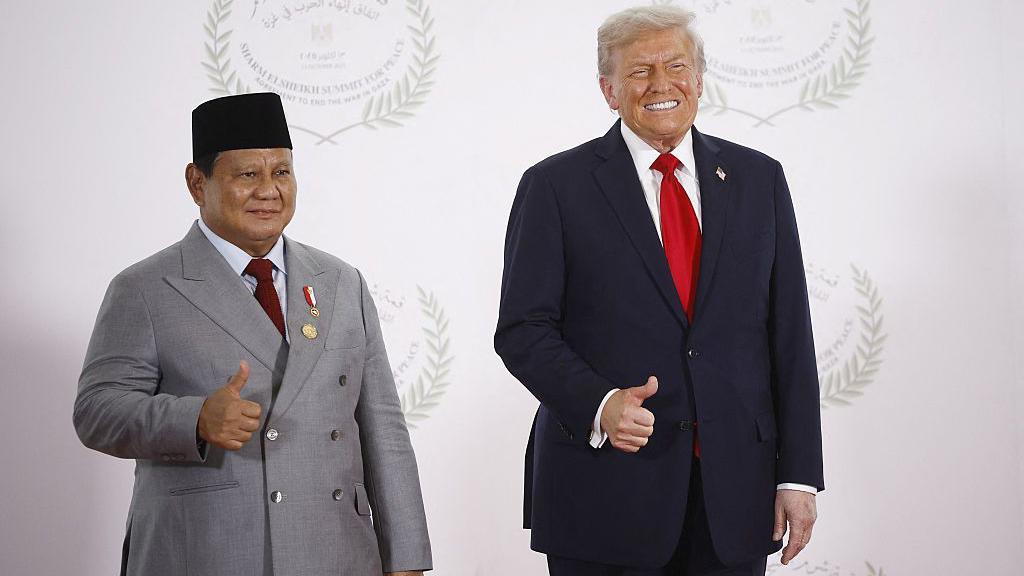

The governments of Indonesia and the United States (US) have finalized a trade tariff agreement following months of negotiations. This decision has been met with various criticisms, notably concerning the leniency introduced for halal certification requirements on products originating from the US.
According to the Agreements on Reciprocal Trade document, signed by both presidents, Prabowo Subianto and Donald Trump, “Indonesia will exempt US products from halal requirements and labeling.”
This provision, detailed in Article 2.9, aims to facilitate the export of cosmetics, medical devices, and other manufactured goods from the United States to Indonesia.
Furthermore, another clause within the agreement stipulates that the Indonesian government must accept “animal slaughter practices in the US” that comply with “Islamic law or SMIIC member country standards.”
In response, Cholil Nafis, Deputy Chairman of the Indonesian Ulema Council (MUI), urged Indonesian Muslim consumers to exercise greater caution when purchasing products. He emphasized that halal certification serves as a rigorous, official guarantee, tested by various institutions through stringent mechanisms.
“Therefore, if there is no halal certification, don’t buy it. Mr. Prabowo went to America wearing a kopiah (traditional cap), but unfortunately, American goods coming here are exempt from halal certification,” he lamented.
Concurrently, Muti Arintawati, Director of the Food, Drug, and Cosmetics Assessment Institute (LPPOM) MUI, pressed the government not to succumb to US pressure regarding halal certification. She highlighted that Indonesia already possesses clear regulations governing halal information on products entering the country.
“Halal regulations in Government Regulation Number 42 of 2024 clearly mandate that cosmetics, medical devices, and related services such as distribution services must have halal certificates, while non-halal products must clearly state their non-halal status,” Muti explained.
Conversely, the Indonesian government, represented by the Ministry of State Secretariat, refuted claims that US products could circulate without halal certification. The government asserted that US products “must still meet halal certification requirements in accordance with applicable regulations.”
Why has the clause on relaxed halal certification ignited such widespread criticism? What are its potential implications for Indonesia’s burgeoning halal industry? And what is the current standing of the halal business sector in Indonesia?
How the US Views “Halal Certification”
The term “halal” appears in two key articles within the reciprocal trade document between the US and Indonesia.
Firstly, Article 2.9 specifically addresses “halal for manufactured goods.” This article outlines four primary provisions:
- The exemption of US products from halal certification and labeling requirements.
- The elimination of halal labels for “containers or other materials” used in transporting manufactured products.
- The non-application of halal labels to non-halal products.
- Indonesia is required to permit any US halal certification body recognized by Indonesian halal authorities to certify imported products “without additional requirements.”
Moreover, Indonesia is encouraged to “streamline the process” for US halal certification bodies to gain recognition from Indonesian halal authorities.
Secondly, the halal clause is found in Article 2.22, pertaining to “halal for food and agricultural products.” This article specifies that “Indonesia will accept animal slaughter practices in the US” that comply with “Islamic law or SMIIC member country standards.”
SMIIC, the Standards and Metrology Institute for the Islamic Countries, is an organization dedicated to developing mechanisms for Organisation of Islamic Cooperation (OIC) member states to establish new standards and remove technical trade barriers. It also aims to set conformity assessment schemes to accelerate the exchange of materials, manufactured goods, and products among OIC countries, notably through mutual recognition of halal certification.
Article 2.22 further details that the US government requested Indonesia to exempt non-animal products and animal feed—whether genetically modified or not—from halal certification and labeling requirements. The US government also urged Indonesia to “exempt containers and other materials” used to transport food or agricultural products from halal certification and labeling requirements.
Additionally, Indonesia is asked to remove US packaging, storage, and warehousing companies involved in the halal agricultural export supply chain to Indonesia from “testing and halal competency certification requirements for their employees.” Finally, Indonesia is encouraged by the US government “not to adopt or maintain any measure” that requires US companies to appoint a halal expert to oversee company operations.
These provisions appear to directly contradict Indonesia’s Law Number 33 of 2014 concerning Halal Product Assurance (JPH), Article 4 of which explicitly states that products entering, circulating, and traded within Indonesian territory “must be halal certified.”
The imperative for halal certification in Indonesia stems from its substantial Muslim population, which, according to Dukcapil Ministry of Home Affairs data, constitutes 87.13% of the total population as of early 2025. The establishment of the Halal Product Assurance Law is rooted in the government’s commitment to “guarantee every religious follower’s ability to worship according to their faith.” In essence, the state is “obligated to provide protection and assurance regarding the halal status of products consumed and used by the community.”
The administration of halal certification is spearheaded by the Halal Product Assurance Organizing Body (BPJPH), in collaboration with various other institutions such as Halal Inspection Agencies (LPH), Halal Product Process Assistance Institutions (LP3H), the Indonesian Ulema Council (MUI), and the Halal Product Fatwa Committee. The scope of halal certification extends beyond domestic boundaries, reaching international markets through BPJPH’s global cooperation schemes. As of October 2025, the Halal Information System reported approximately 9.6 million halal-certified products.
Media Wahyudi Askar, Director of Fiscal Justice at Celios, a non-governmental organization focusing on economic issues, characterized the current situation as “Indonesia’s national halal regime being made more lenient specifically for products from the US.” He views the signing of these halal certification provisions within the reciprocal agreement as a clear indicator that “Indonesia is effectively losing its regulatory sovereignty,” or the autonomy to formulate its own regulations.
“Because the state, ostensibly, has the right to determine domestic standards based on existing legal frameworks,” Askar emphasized to BBC News Indonesia on Monday (23/2). “In Indonesia, the Halal Product Assurance Law is a constitutional mandate with the rationale of consumer protection.” However, with the newly formalized agreement, “Indonesia is compelled to grant special exemptions to the United States,” Askar added. This, he contends, creates “regulatory asymmetry”—an imbalance and unfairness in regulations.
Consequently, domestic products face discrimination. The Halal Product Assurance Law applies to all businesses in Indonesia, including small and medium-sized enterprises (UMKM). While local businesses are obligated to obtain a halal stamp, “US products are precisely exempted,” Askar pointed out, deeming it “unjust.” The long-term implication, according to Askar, is the potential for lawsuits from domestic businesses due to discrimination arising from these halal provisions. Moreover, from a broader perspective, the relaxation of halal certification for US products “contradicts the government’s ongoing campaign target of becoming a global halal industry hub by 2045,” Askar explained. “So, its global branding must be questioned,” he remarked.
Echoing this sentiment, Muti Arintawati, Director of LPPOM MUI, believes the current situation automatically creates an imbalance in competition when local producers bear obligations not imposed on US economic actors. From an international trade perspective, Muti expressed concern about the potential for other countries to demand similar exemptions from halal certification from Indonesia. “We urge the government to provide equal treatment and show favoritism towards local producers and not yield to foreign pressure regarding halal,” Muti stated.
Government: “That is Not True”
Cabinet Secretary, Teddy Indra Wijaya, clarified the circulating issue that US products could enter Indonesia without halal certification, unequivocally stating that the news was “not true.”
Teddy asserted that all products genuinely required to have halal certification must still display an official halal label, whether issued by a halal institution in the US or by authorities in Indonesia. “Products that are mandatorily certified must have a halal label, either from a halal body in the US or a halal body in Indonesia,” Teddy affirmed.
In the US, Teddy continued, halal certificates can be issued by organizations such as Halal Transactions of Omaha (HTO) and the Islamic Food and Nutrition Council of America (IFANCA). In Indonesia, this authority rests with the Halal Product Assurance Organizing Body (BPJPH).
Teddy also ensured that cosmetics and medical devices remain under scrutiny. Both are required to obtain distribution permits and certification from the Food and Drug Supervisory Agency (BPOM) before they can be sold in the domestic market. According to Teddy, Indonesia and the US already have a Mutual Recognition Agreement (MRA) for halal standards. This agreement facilitates the equivalence of halal certification within a framework of global cooperation, without diminishing the standards or oversight applicable in each country.
Voices from the Ground: “Many Disadvantages”
Fahmi Assegaf, a perfume seller in the Kampung Arab area of Pasar Kliwon, Solo, expressed his dissatisfaction with the trade agreement that relaxes halal labeling and certification, sealed by Presidents Prabowo Subianto and Donald Trump. He believes the agreement harms the public and could potentially disrupt market prices due to an influx of cosmetic products, such as perfumes, from the United States.
“We clearly reject it. There are many disadvantages. For me, [the agreement] brings many disadvantages to the Indonesian people, rather than benefits,” Fahmi stated when met at his shop on Monday (23/2). “Indonesians themselves now have their own perfume products, they can make perfumes, and the quality is already improving.”
He expressed personal disappointment with the relaxation of halal labeling, especially when the reference point is the halal certification system in America. Fahmi added that Muslims in the US are a minority, and therefore, halal certification policies should be guided by standards implemented by countries with majority Muslim populations. He cited Indonesia or Saudi Arabia as benchmarks for halal certification policies. “I apologize, but the standard of halal in a Muslim minority country cannot be a benchmark. It refers to that,” he asserted.
Having traded perfumes for over a decade, Fahmi affirmed that the products he sells regularly undergo halal certification. Similarly, goods offered to his shop by other sellers consistently include proof of halal status. “We don’t accept [non-halal products], of course. Why would we take them? Even Europe respects halal labels. If it’s not halal, why would we take it? That’s the logic,” said Fahmi, whose products range from Arab to European origins. “We, forgive me, do not depend on America for our livelihood.”
Fahmi believes the government should thoroughly consider whether the trade agreement with the US yields more positive or negative outcomes. He firmly believes Indonesia is not a small country and that many other nations, beyond the United States, are willing to support trade activities with Indonesia. Beyond disappointment, Fahmi harbors fear. With the eased entry of US products into Indonesia, particularly those without a halal stamp, an “import surge of perfumes” is not an impossible scenario, even though this situation has not yet materialized. Should this occur, Fahmi continued, the ultimate consequence would be “the threatened sustainability of small businesses.” He concluded, “This is a business game. Ultimately, for political interests.”
“Halal Similar to Negotiable Corn and Wheat Tariffs”
Eliza Mardian, a researcher at the Center of Reform on Economics (CORE) Indonesia, posits that with this trade agreement yielding such leniency, the “halal element is no longer fully treated as a religious-constitutional norm.” Instead, Eliza argues, halal provisions have been reduced to a technical instrument “subject to international trade compliance tests.”
“For us, the community, halal is not merely a quality standard but a state obligation towards its majority population, and this is part of the social contract between the state and its citizens,” she told BBC News Indonesia on Monday (23/02).
Eliza believes the halal leniency clause between the US and the Indonesian government serves as a cautionary “yellow light” because “there will be a shift in domestic policy sovereignty.” Observing the trade demands set by the US on Indonesia, Eliza realized how halal certification has transformed into a technical variable “equivalent to corn and wheat tariffs” that can be negotiated. If this policy is indeed implemented, Eliza stated, Indonesia risks shifting from being a “halal-setter” to a “halal-taker.” Meanwhile, Eliza continued, halal product assurance services are likely to be disrupted, alongside losses for local UMKM.
Data indicates that over the last decade, the global halal industry market has shown a sharp increase, driven by rapid growth in the Muslim population. Its growth rate is predicted to remain consistent at 5.2% until at least 2028. “Indonesia, on one hand, instead of exporting halal standards to the world, is adjusting to the trade practices of non-Muslim producing countries,” Eliza explained.
Tauhid Ahmad, Executive Director of the Institute for Development of Economics and Finance (INDEF), believes this trade agreement will proceed even if the US Supreme Court (SCOTUS) issues a ruling overturning President Donald Trump’s global reciprocal tariff policy. “Although the position is still ‘wait and see,’ I think the government, as well as businesses, will move forward. Mr. Airlangga [Hartarto]’s statement yesterday also indicated as much,” Tauhid informed BBC News Indonesia on Monday (23/12).
“The problem is that Indonesia, indirectly, signed that trade agreement.”
Regarding the relaxed halal certification, Tauhid sees potentially significant effects. In Tauhid’s analysis, halal certification targets, among other things, imported products such as beef or chicken. When the US demands leeway, other importing countries—such as Australia, India, and Brazil—are likely to follow suit. Crucially, the relaxation of halal labeling will “shake the existence of the halal mechanism” in Indonesia as a whole, according to Tauhid. From this perspective, Tauhid stated, the government must begin to consider subsequent anticipatory measures to prevent a “chain effect” created by the trade agreement with the US. “For example, emphasizing that this certification relaxation is not extended to other countries, only to the US,” Tauhid concluded.
Journalist Fajar Sodiq in Solo contributed to this report.
Summary
Indonesia and the United States have finalized a trade agreement that includes controversial clauses relaxing halal certification requirements for US products entering Indonesia. Specifically, the agreement exempts US manufactured goods like cosmetics and medical devices, along with certain food and agricultural products, from mandatory halal certification and labeling in Indonesia. It also stipulates that Indonesia will accept US animal slaughter practices complying with Islamic law or SMIIC standards, and streamline the recognition of US halal certification bodies. These provisions appear to contradict Indonesia’s Law Number 33 of 2014 on Halal Product Assurance (JPH), which mandates halal certification for all products circulating in the country.
The relaxed halal clauses have drawn significant criticism from various Indonesian stakeholders, including the Indonesian Ulema Council (MUI) and LPPOM MUI. Critics express concerns over the potential erosion of halal assurance for consumers, unfair competition for local small and medium enterprises (UMKM), and a perceived loss of Indonesia’s regulatory sovereignty, which could jeopardize its ambition to become a global halal industry hub. Conversely, the Indonesian government, through the Cabinet Secretary, denied that US products would circulate without halal certification, clarifying that all mandatorily certified products must still bear a halal label from either recognized US bodies or Indonesia’s BPJPH, facilitated by an existing Mutual Recognition Agreement (MRA) for halal standards.
