
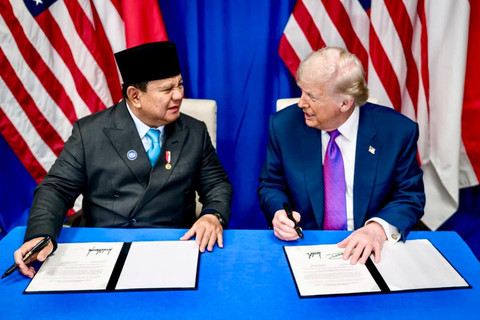

In a significant move for bilateral economic relations, Indonesian President Prabowo Subianto and then-United States President Donald Trump officially signed the Agreement on Reciprocal Trade (ART) in Washington, D.C., on Thursday, February 19th, US time. This landmark signing paves the way for a 19 percent reciprocal tariff agreement benefiting a range of Indonesian products entering the US market.
Following the head-of-state signing, further technical discussions and the finalization of ART’s annexes commenced at the office of the United States Trade Representative (USTR), as explained by Coordinating Minister for Economic Affairs Airlangga Hartarto.
Minister Hartarto highlighted that the ART forms an integral part of the two nations’ broader economic forum under the Council of Trade and Investment. This council is designed to serve as a crucial platform for discussing various facets of trade, investment, and the balance of trade between Indonesia and the United States, fostering deeper economic ties.
“Today, Indonesia and the United States signed the ART with President Prabowo and President Donald Trump. Their bilateral meeting was quite extensive, lasting 30 minutes after the Board of Peace event,” Minister Airlangga stated during a virtual press conference on Friday, February 20th.
Minister Airlangga revealed that this pivotal agreement is the culmination of an intensive negotiation process that began in April 2025, when the US announced its reciprocal tariff policy. Throughout this period, the Indonesian government submitted four official letters and successfully gained US approval for approximately 90 percent of its proposals, demonstrating robust diplomatic efforts.
To secure these favorable terms, Indonesian delegations undertook seven visits to Washington and engaged in more than 19 technical meetings with the USTR, showcasing the depth of commitment from both sides in reaching this comprehensive trade understanding.
“This agreement stands apart from other ARTs with different countries because the US agreed to remove non-economic clauses, such as cooperation on nuclear reactors, defense, and security. This ensures the agreement remains purely focused on trade, making it a truly unique arrangement,” Minister Airlangga emphasized.
Thousands of Indonesian Products Gain 0 Percent Tariff Access
Under the ART agreement, a significant number of Indonesian products—approximately 1,819 tariff lines—will receive preferential access to the US market. This encompasses key sectors such as agriculture and industry, including commodities like palm oil, coffee, cocoa, and spices, as well as high-value goods like electronics, semiconductors, and even aircraft parts.
These diverse Indonesian products are set to enjoy tariffs as low as 0 percent in the competitive US market. Additionally, the apparel and textile sectors will also benefit from a 0 percent tariff through a tariff-rate quota (TRQ) mechanism. This strategic scheme is projected to directly benefit around 4 million workers and positively impact more than 20 million people across Indonesia, boosting employment and economic well-being.
In adherence to the principle of reciprocity, Indonesia will, in turn, grant 0 percent tariffs for several US products, including essential agricultural commodities like wheat and soybeans. This policy is expected to help maintain the stability of domestic food prices, particularly for staple ingredients like instant noodles, tofu, and tempeh, thereby mitigating additional burdens on Indonesian consumers.
To ensure equitable implementation of the agreement, Minister Airlangga affirmed that both parties have established the Council of Trade and Investment to address any price increases that might exceed the agreed terms.
He further elaborated, “All investment and trade issues, including any significant price increases or imbalances in the national trade balance, will be deliberated within this council. The primary objective is to secure robust economic supply chains and uphold the sovereignty of each nation, forming a crucial part of this agreement.”
The ART is slated to come into effect 90 days after the completion of each country’s respective legal processes. This includes consultations between the Indonesian government and its House of Representatives (DPR), as well as internal procedures within the United States.
The Indonesian government views this agreement as a new defining moment in bilateral economic relations. Minister Airlangga even described the ART as ushering in a “new golden age” of Indonesia-US cooperation, a partnership poised to significantly drive trade, investment, and economic growth for both nations.
Summary
Indonesian President Prabowo Subianto and U.S.
