
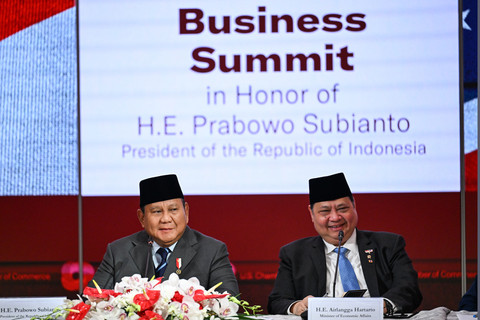

Indonesia and the United States have forged a substantial economic alliance, signing a series of agreements worth over USD 7 billion, equivalent to approximately Rp 118.5 trillion (at an exchange rate of Rp 16,928). These significant deals were inked on Wednesday, February 18, a pivotal day preceding an anticipated meeting between Indonesian President Prabowo Subianto and US President Donald Trump to finalize a broader trade pact. The U.S.-ASEAN Business Council (USABC) confirmed the details of these agreements, which underscore a deepening bilateral economic relationship.
The extensive package of agreements, unveiled through a USABC fact sheet, was formalized during a dinner reception for President Prabowo, hosted by the U.S. Chamber of Commerce. A cornerstone of these accords involves substantial agricultural purchases by Indonesian companies, including 1 million metric tons of US soybeans, 1.6 million tons of corn, and 93,000 tons of cotton, though the specific timeframe for these acquisitions remains undisclosed. Furthermore, Indonesia has committed to importing 1 million tons of wheat this year, with plans to increase this to an impressive 5 million tons by 2030, highlighting a significant boost in agricultural trade.
Beyond commodities, the agreements extend to critical strategic sectors. A key memorandum of understanding was signed between the prominent US mining firm Freeport-McMoRan and Indonesia’s Ministry of Investment and Downstreaming/BKPM, focusing on cooperation in critical minerals. Concurrently, a separate agreement was established between Indonesia’s state-owned oil producer Pertamina and Halliburton for collaboration in oil field recovery efforts. Richard Adkerson, CEO of Freeport-McMoRan, confirmed their initial agreement with the Ministry of Investment/BKPM to extend their mining permit beyond 2041. “This is a resource life extension, and we can’t wait to do delineation drilling to find out what that ore body looks like for decades to come,” Adkerson stated, as quoted by Reuters on Thursday, February 19.

Further diversifying the scope of collaboration, the deals also encompass two semiconductor joint venture agreements. One significant venture, valued at USD 4.89 billion, involves Essence Global Group and its Indonesian partners. Another, with an undisclosed value, will see the participation of Tynergy Technology Group, signaling a growing engagement in high-tech manufacturing.
The USABC provided specific valuations for several components of the agreement, estimating Indonesian soybean purchases at USD 685 million, wheat at USD 1.25 billion, and cotton at USD 122 million. An additional USD 200 million was allocated for the purchase of shredded used clothing from the US for recycling. Providing historical context, data from the U.S. Census Bureau indicates that over the decade from 2015 to 2024, Indonesia consistently imported an annual average of 2.3 million metric tons of US soybeans, nearly 800,000 tons of wheat, approximately 180,000 tons of cotton, and just under 100,000 tons of corn. These figures underscore Indonesia’s crucial role, importing around USD 3 billion in US agricultural products annually, making it the 11th largest market for all US agricultural commodities.
It’s important to note that the total value of all transactions was not fully disclosed, with specifics on Indonesian purchases of US wood products and furniture remaining unrevealed. These recent agreements build upon a previous announcement in July, where Indonesia outlined a series of business deals with the US totaling USD 34 billion as part of ongoing tariff negotiations, including similar wheat and soybean import agreements. During the dinner, President Prabowo clarified that these latest agreements form an integral part of the implementation plan for the broader Indonesia-US trade deal, which he was set to formally sign with President Trump on Thursday, February 19. He expressed confidence that these initiatives would contribute to reducing Indonesia’s trade surplus with the United States. “I am very optimistic about the future of our relationship,” Prabowo affirmed.

President Prabowo’s visit to Washington this week also included his attendance at Trump’s “Board of Peace” meeting. A key objective for Indonesia during these discussions was to secure a slight reduction in tariffs, aiming for 18 percent down from the 19 percent agreed upon last year. Achieving this would align Indonesia’s tariff rate with that granted to India by Trump in early February. While US Deputy Trade Representative Rick Switzer did not disclose the final tariff rate for Indonesia during his remarks at the dinner, he emphasized that the “Agreement on Reciprocal Trade” between the two nations is poised to significantly strengthen bilateral economic and trade relations. “It will mean more trade, bilateral trade. It will mean more investment. It will result in a deeper and more comprehensive economic, investment, and trade relationship,” Switzer concluded, highlighting the broad positive impact anticipated from these renewed partnerships.
