
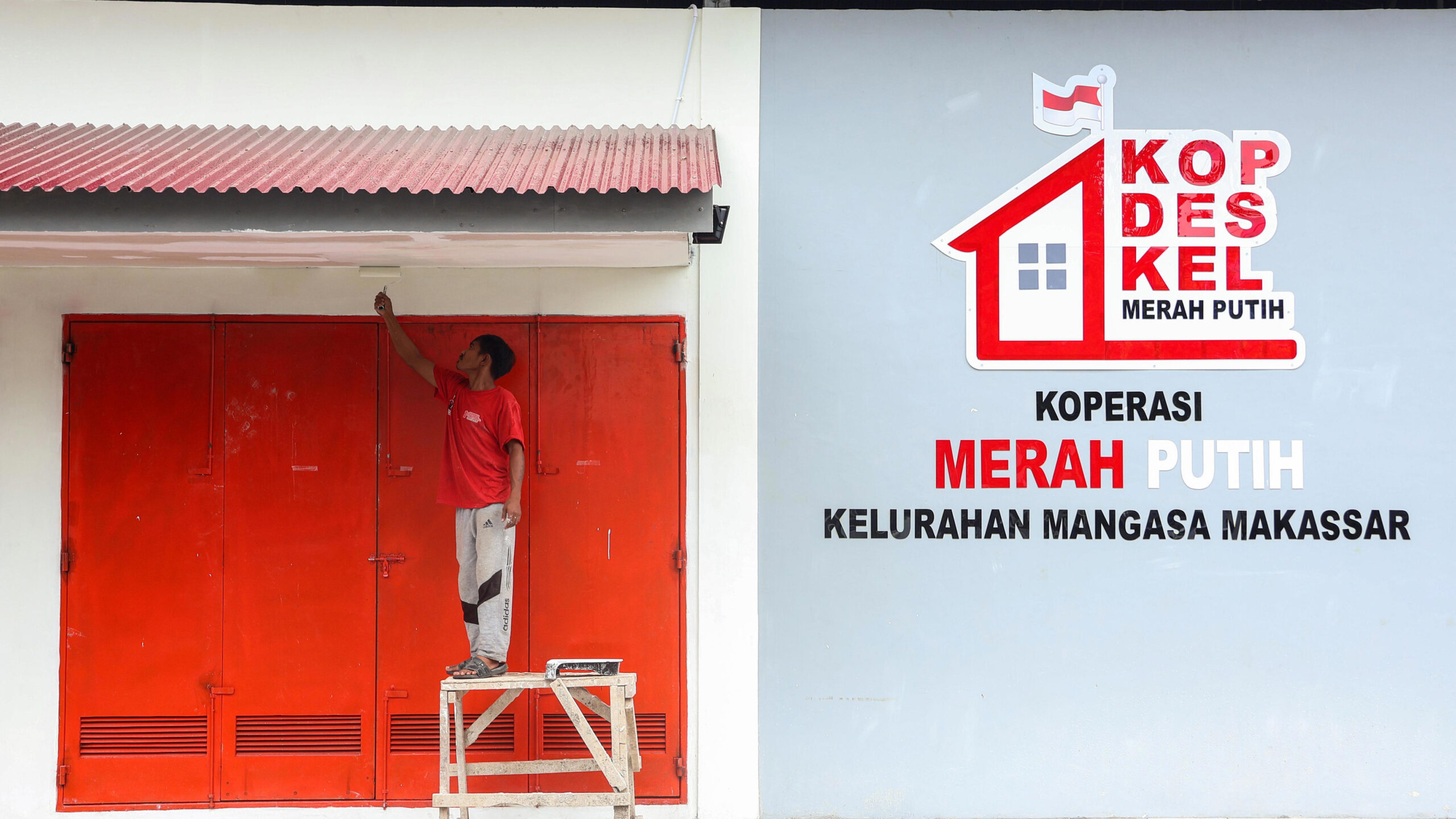

Numerous village heads are vocally opposing a significant 58.03% cut, amounting to Rp34.57 trillion, in the 2026 Village Funds. This substantial reduction is earmarked to support President Prabowo Subianto’s flagship initiative: the Merah Putih Village Cooperatives.
Previously, villages typically received an average of Rp1 billion annually. With the proposed cut, this figure will drastically shrink to a mere Rp200 million-Rp300 million.
Mastur, the Head of Senggigi Village and also Chairman of the Association of All Indonesian Village Governments (Apdesi) in West Nusa Tenggara, expressed deep concern. He stated that such a meager budget would inevitably bring the construction of vital village road infrastructure to a complete halt.
“With a budget of only Rp360 million, we can only focus on health. Infrastructure is simply out of the question. How are we supposed to build infrastructure with such limited funds?” he questioned emphatically.
Adding to the discontent, videos have surfaced on social media showing residents in several regions protesting the establishment of Merah Putih Cooperatives on existing football fields.
Professor Djohermansyah Djohan from the Institute of Internal Government (IPDN) argues that while the Merah Putih Village Cooperatives claim to stimulate the village economy, they cannot possibly replace the fundamental functions of the Village Funds. He further noted that these cooperatives are being established in a top-down manner, suggesting they will “require time to mature” before becoming effective.
“Cooperatives operate in the trade sector, but they cannot construct irrigation systems, repair water channels, or build village roads,” he elaborated.
In contrast, the Minister of Villages, Disadvantaged Regions, and Transmigration (Mendes PDT), Yandri Susanto, maintains that Village Funds are not being reduced. Instead, he describes the changes as a shift in management and utilization, aimed at ensuring the funds are “more targeted” and directly contribute to strengthening village economies.
According to Susanto, the Merah Putih Village Cooperatives represent one crucial aspect of this strategic central government program.
Village Funds Slashed for Merah Putih Cooperatives
The government has confirmed the impending reduction of Village Funds, following the issuance of Minister of Finance Regulation Number 7 Year 2026 concerning Village Fund Management. This regulation, enacted on February 12, 2026, mandates that 58.03% of the Village Funds must be allocated to the Merah Putih Village Cooperatives (KDMP).
Consequently, the 2026 Village Fund ceiling, originally set at Rp60.57 trillion, will see an approximate cut of Rp34.57 trillion, leaving only Rp25 trillion for direct village use.
This stipulation is explicitly outlined in Article 15 paragraph 3 of the regulation:
“The allocation adjustment resulting from the Government’s policy to support the implementation of KDMP, as referred to in paragraph 2, is calculated at 58.03% of each Village’s Village Fund ceiling or Rp34.57 trillion.”

Furthermore, Article 20 paragraph 1 letter e states:
“Village Funds are prioritized for sustainable development, including support for KDMP implementation. The budget is to be used, among other things, for installment payments for the physical construction of outlets, warehousing, and KDMP facilities.”
Article 26 paragraph 2 specifies that the disbursement of Village Funds to support KDMP must be officially ratified as a realization of each village’s Village Fund through a Ministerial Decree before the 2026 fiscal year concludes.
Prior to the publication of this regulation, Coordinating Minister for Food Zulkifli Hasan had asserted that the operational budget for KDMP would originate from loans provided by the State-Owned Banks Association (Himbara). It was estimated that each cooperative would require approximately Rp3 billion in initial capital, with loan repayments structured over six years.
Zulkifli also claimed that the establishment of 80,000 cooperatives, mandated by President Prabowo Subianto through Presidential Instruction Number 9 Year 2025, would invigorate the rural economy and is projected to create employment opportunities for over 2 million young people in villages.
Senggigi Village, NTB, Left with Rp360 Million in Village Funds
However, many village heads remain steadfast in their rejection of these budget cuts.
Mastur, the Head of Senggigi Village and Chairman of Apdesi West Nusa Tenggara, clarified that while his association does not object to the presence of the Merah Putih Village Cooperatives, he strongly disagrees with the method of funding them by cutting existing Village Funds.
He further revealed that in West Lombok Regency, the average cut to Village Funds ranges between 70% and 80%, far exceeding the 58% official figure.
“The Village Fund cut isn’t 58%, it’s 70%,” he stated during a telephone interview.

This means that Senggigi Village, which previously received Rp1.3 billion annually, will only receive Rp365 million in 2026.
Mastur explained that the funds they typically received were primarily allocated for crucial projects such as road construction in hilly hamlets, irrigation channels, drainage systems, and the creation of ditches. This was essential because regional budgets (APBD) often do not adequately reach the villages.
Additionally, 10% of Senggigi’s Village Funds were channeled into capital for Village-Owned Enterprises (BUMDes) and for improving public health initiatives, including efforts to reduce stunting.
With the drastic cuts, infrastructure projects are certain to grind to a halt.
“The most affected area will be village infrastructure, particularly the construction of paving or hardened roads,” he lamented.
“With this Rp360 million budget, we can only focus on health, specifically tackling stunting and providing nutritious food for toddlers or the elderly. For infrastructure, it’s impossible. How are we supposed to build infrastructure with such limited funds?” Mastur reiterated.
The Merah Putih Village Cooperative has not yet been established in Senggigi. However, Mastur mentioned that its location would utilize local government land in each respective village. He pointed out the irony, claiming that his village already possesses numerous existing structures, like storefronts, that could be repurposed, thus negating the need for new construction.
“In Senggigi, we already have stores. But we are mandated to build 25 new shop-houses. The old buildings must be demolished or leveled first, then we build again. This is a waste of budget,” he argued.
Based on his observations in West Lombok Regency, 10 out of 109 villages have already established KDMP. “However, across West Nusa Tenggara as a whole, 99% of KDMP units have been formed. Their management is independent and cannot include village staff or officials,” he added.
He expressed hope that President Prabowo Subianto would re-evaluate the decision to cut the Village Funds.
Pandes Village, Central Java, Left with Rp373 Million in Village Funds
Heru, the Head of Pandes Village in Wedi District, Klaten, Central Java, could not conceal his disappointment. In 2025, his village’s budget reached Rp1 billion, but it has now plummeted drastically to approximately Rp373 million, signifying a cut of over 58%.
“All village heads were shocked by this significantly reduced budget,” he shared.

Despite his disappointment, Heru views these cuts as a necessary consequence of national policy, aimed at realizing President Prabowo Subianto’s vision. Consequently, he feels unable to reject or oppose the decision.
Heru explained that historically, his village’s funds were utilized to run programs supporting essential citizen services, including accelerating the reduction of stunting. Community-based health services in his village, ranging from Posyandu for toddlers and teenagers to Integrated Guidance Posts (Posbindu) and 11 Posyandu for the elderly, have been well-developed and routinely operational.
“All of these have been running smoothly, and with this reduction, we have to rethink how to keep these activities going,” he expressed.
He also recounted how the Village Funds had significantly boosted infrastructure development and community empowerment. He now fears that these cuts will diminish the village’s autonomy.
To supplement the village treasury, Heru plans to maximize Village Original Income (PADes) and reignite the spirit of community self-help to bridge the budget deficit. Some programs deemed less urgent, such as a cultural event to commemorate the legendary artist Narto Sabdo from his village, will unfortunately be postponed. This event, envisioned as a carnival and performance, aimed to establish the maestro as a village icon and foster an economic zone.
“We want to honor his name as the pride of the village. But with the current situation, it will most likely be postponed or we’ll need to seek other funding sources like CSR or community self-help,” he elaborated.
In terms of infrastructure, the village hall, inaugurated last year, stands as their sole hope, expected to contribute to PADes and support other activities. However, vital agricultural irrigation network development can practically no longer be financed by Village Funds.
“We will focus on what is truly urgent. For irrigation, at a minimum, we’ll rely on communal efforts to clean channels so that agricultural production isn’t disrupted.”
Regarding the construction of the Merah Putih Village Cooperative outlet in his village, Heru mentioned that it is still in progress. Its location will utilize village land previously designated for a rest area within the planned economic zone. He hopes that once the KDMP is operational, it can shorten the distribution chain for essential goods, thereby contributing at least 20% of its profits to PADes.
“If I could choose, the Village Funds have proven to be immensely beneficial to the community. But what else can be done? This [KDMP] is already policy. Agree or disagree, what’s the use?” he said, resignedly.
Football Fields Converted into Merah Putih Cooperative Offices
On social media, widespread public rejection of the Merah Putih Village Cooperatives has erupted in several areas due to plans to construct cooperative offices on existing football fields.
A viral video circulating on social media captured residents of Tempurejo Village, Wates District, Kediri, Central Java, removing bamboo stakes from their village field. Voices in the video expressed outrage that a cooperative building was being erected on a field where children play.
Satu lagi proyek pemerintah yg ngeselin selain MBG..
Koperasi Desa Merah Putih..Kalo mau bangun gedung koperasi suka² mreka, mau di lapangan bola, di sekolah²…
Mentang² asuhan kodim setempat.. pic.twitter.com/6R7ObFdSHz— Sυɳαɳ Sαɾƙҽɱ 𝙎𝙑𝘿 (@TaliUdeng) February 14, 2026
A similar issue emerged in Candisari Village, Sambeng District, Lamongan, East Java, where residents are rejecting the proposed conversion of their football field into a cooperative. Locals emphasize that the field is the village’s sole open sports facility and a vital public space for sports and community activities.
Analogous objections have also been raised by residents in Hargantoro Village, Tirtomoyo District, Wonogiri, and Pati in Central Java. Another viral video showcases the frustration of Pati residents confronting an individual believed to be a government representative. Residents reportedly voiced strong disapproval over their village’s football field, a crucial sports facility for local youth, being repurposed for the village cooperative.
Why Merah Putih Cooperatives Are Predicted Not to Last
Eduardo Edwin Ramda, a researcher from the Committee for the Monitoring of Regional Autonomy Implementation (KPPOD), speculates that the government might be struggling to finance President Prabowo Subianto’s ambitious project. He points to the initial plan to fund the Merah Putih Village Cooperatives through bank loans, especially after Finance Minister Purbaya reportedly injected Rp200 trillion into several Himbara banks.
However, he notes that these hundreds of trillions of rupiah never reached the communities. “This implies that the banks themselves don’t trust it. How can the state then decide that everything will be fine?” Eduardo Edwin questioned on Monday (16/02).

“We see that this KDMP program has never undergone a feasibility study to determine if it’s viable for simultaneous nationwide implementation. There has been no such assessment to date.”
Ramda predicts that in practice, the introduction of the Merah Putih Village Cooperatives will create new problems.
Firstly, the drastic 58% cut to Village Funds will undoubtedly sacrifice village infrastructure. This is because the majority of village roads and facilities are typically repaired using these funds. “Villages, which previously had relative flexibility to repair roads, pave areas, or concrete alleyways, will automatically cease such development once the budget is slashed,” he explained. “Ultimately, the community bears the brunt,” Eduardo stated.
Secondly, according to Eduardo, the presence of KDMP could disrupt existing local businesses. He suggests that if cooperatives solely rely on savings and loan schemes, they are unlikely to endure given the abundance of existing microcredit facilities. Initially, these government-backed cooperatives aimed to provide easier access to low-interest capital for MSMEs at the village level. However, their scope has since expanded to include grocery stores, village clinics and pharmacies, storage facilities, and even logistics distribution services.
“Currently, many small shops already exist in each village. Has any mitigation been considered if KDMP opens a grocery store? Many people earn their living from running those small shops,” Eduardo queried. “In my view, this cooperative will become a ‘rival entity’ to existing village businesses,” he asserted. “And when the cooperative’s budget is drawn from Village Funds, it will automatically create an unbalanced business competition,” Eduardo added.

Thirdly, Eduardo believes the Merah Putih Village Cooperatives risk failing just like many Village-Owned Enterprises (BUMDes), primarily because they are often managed by individuals lacking business acumen. BUMDes were mandated by the Village Law enacted in 2014. Out of 39,149 BUMDes formed by 2017, many have failed, become dormant, or have yet to contribute meaningfully to village original income.
If KDMP is not managed professionally and is merely established for the sake of it, Ramda is convinced that President Prabowo Subianto’s project will suffer a similar fate. “Especially if this program does not stem from a feasibility study, it will not run well because it’s rushed, instructive, and top-down.”
‘Cooperatives Cannot Build Roads and Irrigation’
Professor Djohermansyah Djohan from the Institute of Internal Government (IPDN) highlighted that since the enactment of Law Number 6 Year 2014 concerning Villages, significant amounts of Village Funds have been disbursed. Over the last decade, villages have, on average, received more than Rp1 billion annually. However, with President Prabowo Subianto’s new project, each village will now only receive approximately Rp200 million-Rp300 million.
Djohan acknowledged that some village heads have been implicated in corruption cases, and he conceded the government’s argument that Village Funds have not always optimally impacted the welfare of rural communities. However, he argued that the core problem lies not with the existence of the Village Funds themselves, but rather with their management system.

“Large funds with immature governance certainly carry risks. In practice, these funds are managed by village heads and their officials, who are also political actors chosen through direct elections,” Djohan explained. This situation creates a fertile ground for conflicts of interest, especially given the considerable political costs of village head elections, which often lead to pressure to “recoup investments.”
Another issue, according to Djohan, is that villages are not entirely free to determine priorities based on local needs. Village policies are frequently dictated by the central government. Yet, every village possesses unique requirements and has the right to autonomy. “Some need irrigation, some need village roads, some require MSME strengthening. But the central government often mandates allocation for specific sectors,” he remarked.
Amidst these challenges, the government is paradoxically pushing for the establishment of Merah Putih Village Cooperatives as a new engine for village economic development. Conceptually, he noted, cooperatives can indeed bolster the distribution of fertilizers, basic necessities, and access to financing. However, he stressed that cooperatives cannot simply replace the functions of Village Funds.
“Cooperatives operate in the economic trade sector. But cooperatives cannot build irrigation, repair water channels, or construct village roads,” Djohermansyah reiterated.
Djohan also emphasized that cooperatives built in a top-down manner will require considerable time to mature. He warned that if Village Funds are used as collateral or reduced to support these cooperatives, the inevitable risk is the stagnation of physical development and essential basic services in villages.
Therefore, he argued, if the government believes Village Funds are not being maximally utilized, the rational course of action should be to improve management, strengthen oversight, and enhance the capacity of village administrators.

He further pointed out that self-sufficient villages, through transparency and community participation, have demonstrated how Village Funds can indeed become a powerful catalyst for local economies. The challenge, however, is that the number of villages truly ready in terms of managerial capacity remains limited.
Reducing Village Funds without simultaneously strengthening villages’ original sources of income, in his view, risks stagnating physical development and basic services. Meanwhile, relying solely on cooperatives as a singular solution demands both time and structural readiness.
“Villages still require state incentives. This is not charity, but rather an integral part of recognizing the historical rights of villages,” he asserted.
What Is the Government’s Response?
BBC Indonesia attempted to contact the Minister of Cooperatives, Ferry Juliantono, but did not receive a response.
Earlier, the Minister of Villages, Disadvantaged Regions, and Transmigration (Mendes PDT), Yandri Susanto, stated that Village Funds were not being reduced, but rather undergoing a change in their utilization and management. The objective, he explained, is to ensure they are more accurately targeted and directly contribute to strengthening village economies.
“Village funds are not decreasing; what is being changed is how they are used, their allocation, and their management system,” Yandri remarked at the end of January.
He reiterated that one manifestation of this change is the introduction of the Merah Putih Village Cooperatives, which is a strategic program of the central government.
Yandri claimed that nearly 30,000 cooperatives have already been established in various regions. If managed effectively, he projects that at least 20% of their profits will be returned to the villages, while all cooperative assets will become village property.
Journalist Kamal in Central Java contributed to this report.
- Koperasi Merah Putih (Merah Putih Cooperatives) launched by Prabowo – Potential for trillions in corruption and budget leaks, can it be prevented?
- Is Koperasi Merah Putih what farmers need? – ‘We are traumatized by models like this’
- Pati Regent, Sudewo, named suspect in two KPK corruption cases – How did he do it?
- Government’s Rp200 trillion injection into banks, what should you know?
- Thousands in Klaten regularly receive Eid bonuses from village heads, where does the money come from?
- ‘If village heads’ terms are nine years, they will be more adept at corruption’
- Flow of funds to fictitious villages: A portrait of ‘poor oversight’ in managing tens of trillions of rupiah?
- Government claims extreme poverty will be 0% by end of 2024, but in Papua, surviving ‘requires immense struggle’
- Half a million Indonesian households live without electricity, can clean energy be a solution?
- Why does malnutrition still haunt Asmat? – Stories from remote villages in inland South Papua
- Gibran appointed to solve problems in Papua – What does Gibran need to do?
- Protecting Jewish residents from Nazis, a French village receives a ‘substantial’ legacy
Summary
Numerous village heads are vocally opposing a significant 58.03% cut, amounting to Rp34.57 trillion, in the 2026 Village Funds. This substantial reduction, formalized by Minister of Finance Regulation Number 7 Year 2026, is earmarked to support President Prabowo Subianto’s Merah Putih Village Cooperatives (KDMP). The average village allocation will drastically shrink from Rp1 billion to approximately Rp200 million-Rp300 million, severely hindering vital infrastructure development and essential services. Village heads, like Mastur from Senggigi, express deep concern, noting actual cuts can be even higher, reaching 70-80% in some regions.
Critics, including Professor Djohermansyah Djohan and researcher Eduardo Edwin Ramda, argue that KDMP, established in a top-down manner, cannot replace the Village Funds’ role in building infrastructure, as cooperatives primarily operate in trade. Concerns also highlight the potential disruption to existing local businesses, a lack of comprehensive feasibility studies, and risks of mismanagement. Conversely, the Minister of Villages, Yandri Susanto, maintains that Village Funds are not being reduced but rather undergoing a shift in utilization and management to be “more targeted” and strengthen village economies through this strategic central government program.
