
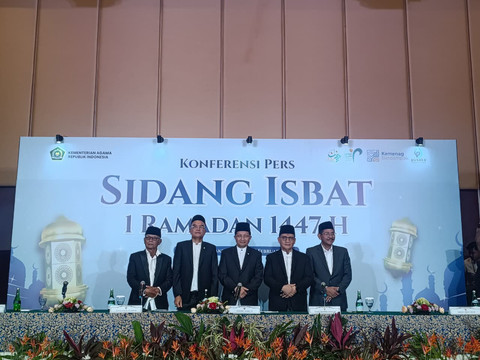

The official Isbat Session, convened at the Borobudur Hotel in Central Jakarta on Tuesday, February 17, has concluded that the first day of fasting for Ramadan will commence on Thursday, February 19. This ruling from the government-sanctioned session creates a divergence from the determination by Muhammadiyah, one of Indonesia’s largest Islamic organizations, which set the beginning of Ramadan for Wednesday, February 18.
While such differences in establishing religious dates are often acknowledged as natural and even reflective of a unique cultural richness, a clear desire for greater unity has emerged. Marwan Dasopang, Chairman of Commission VIII of the Indonesian House of Representatives (DPR RI), highlighted that the Minister of Religious Affairs, Nasaruddin Umar, is actively pursuing a synchronized start date for fasting across the nation.
“During our discussion, a clear perspective emerged that moving forward, the Minister of Religious Affairs will strive to bring together differing viewpoints for the determination of the 1st of Ramadan,” Marwan stated, echoing the Minister’s long-term objective.
Marwan expressed his firm support for this crucial initiative. “As the Chairman of Commission 8, we will undoubtedly back efforts to reconcile these perspectives, enabling us to collectively observe religious practices, not only during Ramadan but also for the subsequent Syawal (Eid al-Fitr),” Marwan affirmed, underscoring the broader impact of achieving calendrical harmony.
Minister Nasaruddin Umar, outlining his strategy to achieve this ambitious goal, indicated his commitment to becoming an active listener. He plans to engage extensively with all Islamic organizations in Indonesia, ensuring their voices are heard. Furthermore, he intends to consult a diverse range of experts in their respective fields to gather comprehensive insights.
“I believe that my initial step as Minister of Religious Affairs will be to become an active listener to all existing Islamic organizations,” Nasaruddin emphasized, signaling a collaborative and inclusive approach.
He further elaborated on the process, stating, “Through this engagement, we will then develop robust concepts and actively seek input from experts in their specialized areas.” This methodical approach aims to build a consensus grounded in both community understanding and scientific expertise.
Despite the historical recurrence of these calendrical disparities, Nasaruddin expressed strong optimism that such challenges can be resolved. He pinpointed two critical areas for resolution: the necessity for methodological adjustments and, crucially, the importance of curbing individual and organizational egos for the sake of collective good.
“I am incredibly optimistic that, God willing, we can resolve this issue in the future. The important thing is for each of us to have our methodologies, and to curb those egos. So, everyone needs to adapt and make adjustments,” Nasaruddin explained, calling for mutual understanding and flexibility.

Nasaruddin further revealed a potential challenge: if the current methodology, which primarily relies on the physical visibility of the crescent moon (wujud hilal), remains unchanged, there is a significant risk of differing dates persisting for the next four years. This highlights the urgency of re-evaluating and potentially enhancing the current approach.
“If we consistently rely solely on the height or visibility of the crescent moon, there remains a very high risk of differences for the next four years. Therefore, it is imperative that we strengthen our methodology going forward,” Nasaruddin stressed, underscoring the need for a more robust and unified approach.
The Minister’s hope for a unified Ramadan start date is not without historical precedent. He pointed out that for several decades following Indonesia’s independence, there was a consistent unity in determining the start of Ramadan. This historical harmony serves as a powerful reminder that agreement is achievable.
“The fact is that for many decades in the early years of independent Indonesia, there was always unity, wasn’t there? Especially when the government’s decision, represented by the Minister of Religious Affairs, was accepted by all parties because there was a consistent and agreeable methodology at that time,” Nasaruddin concluded, reinforcing the idea that a shared methodological framework is key to fostering widespread acceptance and religious unity.
Summary
The official Isbat Session determined the start of Ramadan on Thursday, February 19, which differs from Muhammadiyah’s start date of Wednesday, February 18. In light of these recurring discrepancies, Religious Affairs Minister Nasaruddin Umar is actively pursuing a synchronized start date for fasting across Indonesia. This initiative, supported by Commission VIII of the DPR RI, aims to foster greater unity in observing religious practices, including Ramadan and Syawal.
Minister Nasaruddin plans to engage extensively with all Islamic organizations and consult experts to develop a unified methodological concept. He expressed optimism but emphasized the need for methodological adjustments and curbing individual or organizational egos. The Minister highlighted that continuing with the current crescent moon visibility method risks differing dates for the next four years, underscoring the urgency for a more robust and unified approach, recalling the consistent unity achieved for decades following Indonesia’s independence.
