
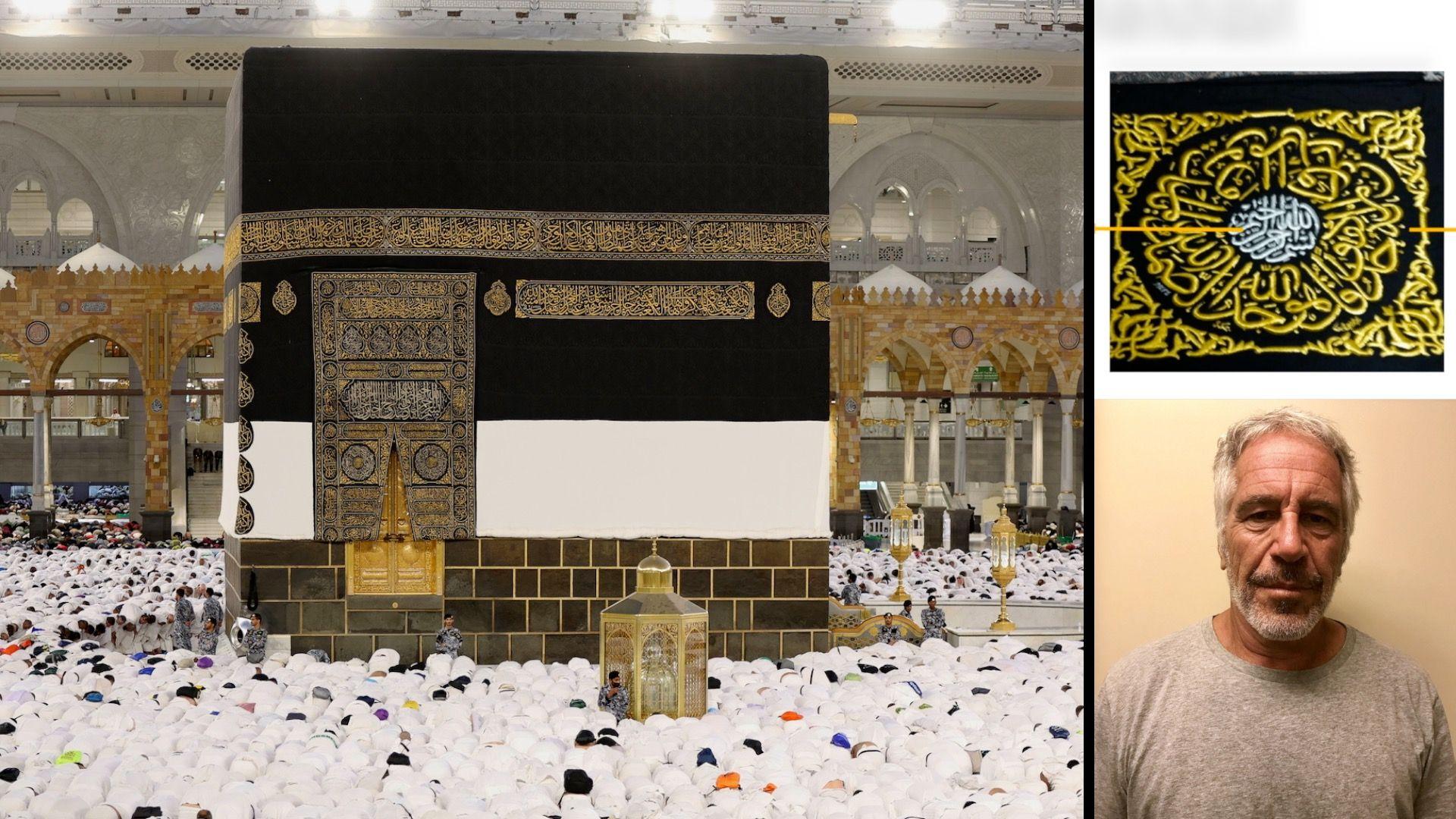

Muslims worldwide have expressed outrage over recently unsealed documents revealing that the Kiswah, the sacred cloth covering the Ka’bah, was reportedly sent to the late convicted sex offender Jeffrey Epstein. This revelation emerged from Epstein’s files, released by the US Department of Justice (DOJ) in late January.
Email exchanges from 2017 detail the purported shipment of three pieces of the Kiswah from Saudi Arabia to Epstein’s Caribbean residence. The sentiment online was succinctly captured by one X user who wrote, “Imagine sending a cloth from the holiest place on Earth to the dirtiest!” Adding to the controversy, a 2014 photograph shows Epstein and another man inspecting a piece of cloth on the ground, resembling the highly ornamented section of the Kiswah that covers the Ka’bah’s entrance.

Another X user expressed their profound dismay, stating the image “broke my heart into pieces” seeing the Kiswah “spread out on the floor like a rug.” It’s important to note, however, that this specific photograph doesn’t appear to be directly linked to the 2017 documented shipments, and the authenticity of the cloth depicted remains unconfirmed.
The Significance of Ka’bah Cloth Shipments
The significance of the alleged shipment of Ka’bah cloth pieces to Epstein is underscored by the immense spiritual value Muslims place on the Kiswah. Crafted from black silk, the Kiswah is adorned with verses from the Quran intricately embroidered in gold and silver threads. It drapes all four exterior walls of the Ka’bah in Mecca. Annually, after being touched by millions of Hajj pilgrims, the Kiswah is replaced with a new one during a ceremonial event marking the Islamic New Year.
The DOJ archives reveal correspondence between Epstein’s staff and an email account under the name “Aziza al-Ahmadi,” who seemingly orchestrated the 2017 shipment of three Kiswah pieces to Epstein. These included a green piece, described as originating from the interior of the Ka’bah; a black cloth from the used exterior layer; and an unused embroidered carving made from the same material.

An email dated February 1, 2017, from an assistant to Ahmadi, informed Epstein’s staff that they would be “sending some Ka’bah cloth pieces for the mosque.” The intended recipient or location of this “mosque” — whether on Epstein’s property or elsewhere — remains unclear. While a “mosque” on Epstein’s private island has not been explicitly mentioned in the reviewed files, DOJ documents do reference a small building referred to as a “temple” on Little St. James Island. The exact meaning within the correspondence is ambiguous. The temple on Little St. James Island is described as a small building on the southern part of the island, distinctive for its golden dome. Crucially, the “mosque” referenced in these documents should not be conflated with the Grand Mosque in Mecca.
The documents reveal that the shipment first arrived at Epstein’s Palm Beach residence on March 4, 2017, before being forwarded to St. Thomas in the US Virgin Islands. This location is proximate to Little St. James, Epstein’s private island, where several of his sex abuse victims allege they were taken and subjected to abuse. Intriguingly, a US Customs form dated March 14, 2017, declared the shipment as “paintings, drawings, and sculptures” with a stated value of US$10,980 (approximately Rp183 million). An email dated March 21 subsequently confirmed the delivery of the Kiswah pieces to “Epstein’s home.”
Following the delivery, an email from Ahmadi’s account informed Epstein that the black cloth had “been touched by at least 10 million Muslims of various denominations – Sunni, Shia, and others.” The email further detailed the spiritual significance: “They walk around the Ka’bah seven times, then everyone tries their best to touch it, and they place their prayers, hopes, tears, and dreams on this cloth.” It remains uncertain whether Epstein received these Kiswah pieces as a gift or if their authenticity was fully verified.

This Kiswah shipment, however, was not the first from Saudi Arabia to Epstein, according to the recently unveiled DOJ files. A January 27, 2017, email chain shows Ahmadi’s alleged assistant requesting “photos of the mosque interior” to facilitate preparations for “something inside the mosque.” Earlier in that same exchange, Epstein’s assistant confirmed the arrival of “tents and other household items” at his residence. DOJ files include documents picturing traditional Arab wool tents and various other items such as carpets, coffee pots, cups, and baskets. However, it cannot be definitively confirmed if these are the exact items sent to Epstein in this particular shipment. Both shipments reportedly occurred after Epstein’s 2008 conviction for sex offenses, where he pleaded guilty to two counts of soliciting prostitution, including with a minor. Ahmadi has not responded to the BBC’s request for comment. It’s crucial to reiterate that the presence of names in these documents does not inherently imply wrongdoing.
Highly Revered, Traditionally Bestowed Upon State Leaders
The Saudi Arabian government maintains comprehensive control over the Kiswah, from its intricate manufacturing and installation to its eventual removal and the disposition of the old cloth. While there are no explicit regulations governing the distribution of the old Kiswah, its handling is culturally significant. The BBC reached out to the Saudi government for additional information but had not received a response at the time of publication.
Ahmed al-Halabi, a specialist writer on Hajj and Umrah, informed BBC News Arabic that “pieces with gold and silver embroidery, often referred to as ‘Belt’ and ‘Samadias,’ can only be bestowed by Saudi Royal Palace officials.” He further elaborated that “these pieces are typically presented to Muslim heads of state and their government officials,” while “remaining black cloth is usually cut into smaller sections and may be given to lower-ranking officials.”
Dr. Simon O’Meara, an Islamic art historian at SOAS University of London, clarified that while the Kiswah is not “inherently sacred,” it commands immense reverence among Muslims. He emphasized, “They respect the covering of the Ka’bah building. Once the Kiswah is removed, it must not be defiled. People should not step on it.” Al-Halabi, however, also raised questions regarding the authenticity of the Kiswah pieces mentioned in the DOJ correspondence, adding that it is generally not permissible to give Kiswah to non-Muslims.
Epstein’s Saudi Connections
The DOJ files also reveal extensive email correspondence between Epstein and an account signed under the name Ahmadi, spanning from early 2016 to early 2019, covering a wide range of topics. Some of these emails refer to Epstein as “boss” and “master,” suggesting a close relationship, and documents indicate they met in various locations, including New York and Paris. Notably, Epstein appears to have sought to exert influence on the Saudi government through Ahmadi, according to the released DOJ documents.
In July 2016, an email signed by Ahmadi indicates an attempt to arrange a meeting between Epstein and “HE Raafat,” who was described in the email as someone who “enjoys” Epstein’s presence. “HE” likely stands for “His Excellency,” a title for senior government officials in Saudi Arabia. DOJ documents further reveal Epstein’s advice on a “financial health check” and his opposition to the public listing of Aramco, Saudi Arabia’s state oil company, conveyed in an August 2016 email to Ahmadi. In response, Ahmadi reportedly stated they would “review” the matter, including an email address for “Raafat Alsabbagh.”
A November 2016 email from one of Epstein’s assistants explicitly stated: “Aziza is HE Raafat’s assistant.” In other emails to different recipients, Epstein characterized “Raafat Alsabbagh” as an “advisor” to the “Saudi crown prince.” An official statement from the Saudi Press Agency in 2017 identified Alsabbagh as a “consultant at the Royal Court.” A person named “Sabbagh” appears to have corresponded frequently with Epstein, as evidenced by emails in the DOJ files. A 2016 text message from an account named “Raafat Al-Sabbagh” to Epstein read: “I appreciate your friendship.”
Disturbingly, an email from the “Raafat Alsabbagh” account to Epstein included a link to a news article about a 17-year-old Russian beauty queen reportedly fleeing to Dubai to sell her virginity. The convicted sex offender’s chilling reply was: “Finally you send something useful.” Information concerning Ahmadi himself within the files is limited. However, in a September 2018 email, someone with that name appears to have sought Epstein’s advice regarding their mobile gaming company. Numerous questions persist regarding the Kiswah shipment and the broader connections between Epstein and the individuals named in these emails. Across the Muslim world, there are growing calls for Saudi authorities to launch a comprehensive investigation into these troubling revelations.
