
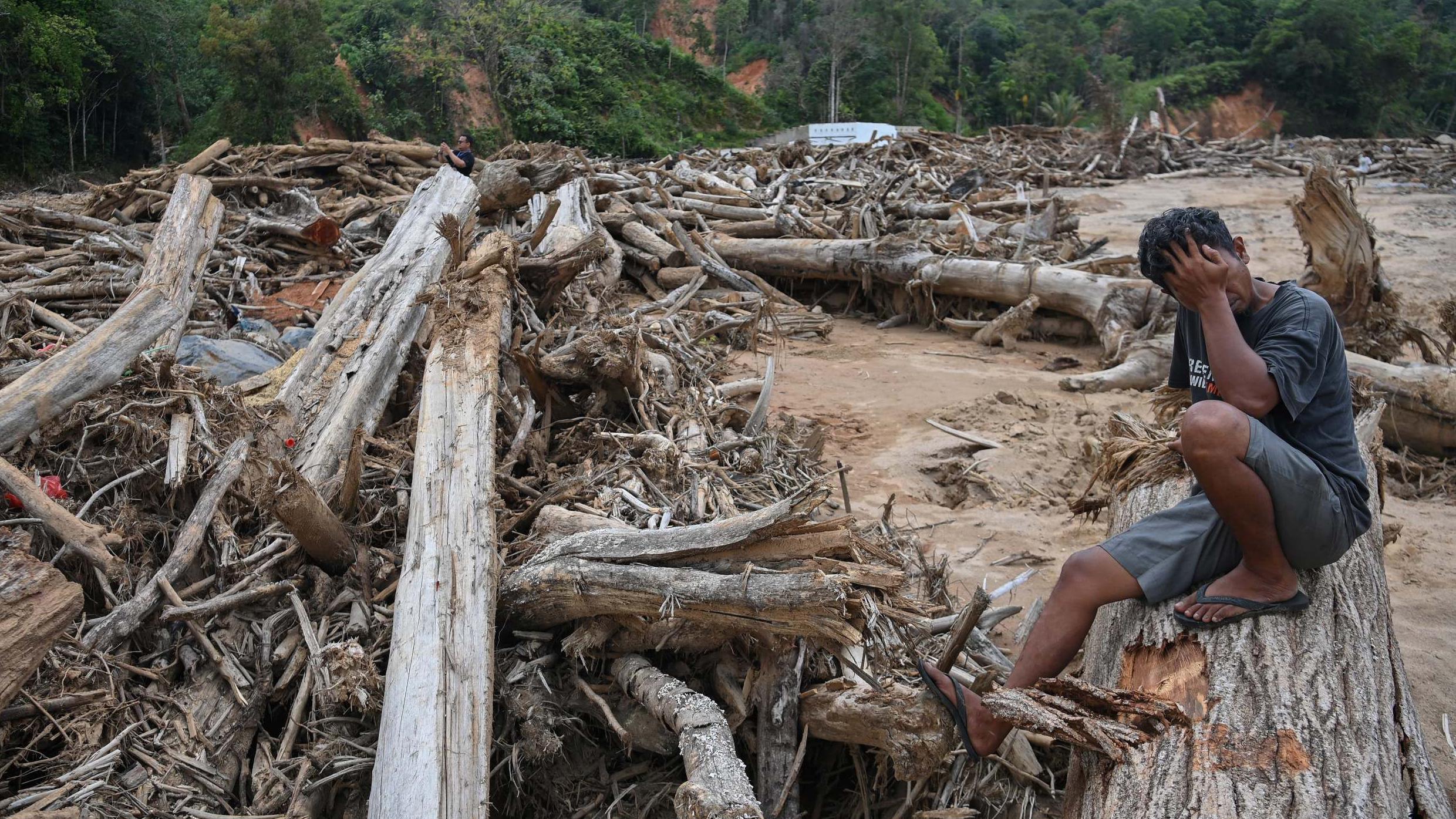

Barely three months after a devastating flash flood and landslide, the residents of Hutanabolon Village in Central Tapanuli, North Sumatra, were once again struck by flooding last Wednesday, February 11th. This is the harrowing account of three survivors grappling with an unending cycle of disaster.
“Panic gripped many, and tears flowed freely,” recounted Rinilorensa Sinaga via phone on Thursday, February 12th, describing the chaos that enveloped her community.
Rini, as she is known, is a resident of Hutanabolon Village, Tukka District, Central Tapanuli, North Sumatra. Her village was utterly devastated by floods and landslides in late November 2025. Just when they began to pick up the pieces, another flood swept through last Wednesday, February 11th.
“We never imagined that the flood from last year would happen again,” she told journalist Nanda Batubara, reporting for BBC News Indonesia.
The 23-year-old’s home, situated relatively close to the riverbank in Lingkungan IV, was completely engulfed by water and logs five months ago. The terrifying specter of that disaster returned to haunt her and fellow villagers.
Panic intensified as the river suddenly overflowed just hours after heavy rains last Wednesday. Rini and other residents scattered, desperately seeking safety. Some wept hysterically, amplifying the already dire situation.
When the deluge struck, Rini had just returned from church, finding herself in the exact same location as when the flash flood ravaged her village in late November 2025. On that occasion, her only remaining possessions were her mobile phone and the clothes on her back.

Since the initial disaster, Rini, her parents, and three siblings have been sheltering at a neighbor’s home on higher ground, just meters away from their former residence, which was completely flattened. Three other families also share this temporary refuge.
Rini’s family opted not to use the government-provided evacuation tents, deeming the conditions scarcely better. She described life in the tents as equally miserable, plagued by heat and vulnerability to rain.
‘I was frustrated and didn’t want to go to college anymore’
Nearly three months after the initial catastrophe, life in Hutanabolon Village remained far from recovery. Beyond material possessions and homes, many residents had also lost their livelihoods, profoundly impacting their mental well-being, including Rini’s.
All of Rini’s important documents and academic essentials, including her laptop containing crucial university files, vanished. This profound loss led her to consider dropping out of college. “I was frustrated and didn’t want to go to college anymore because my diploma was gone, my laptop was gone. Essentially, I had no tools left to pursue my education,” she lamented.
Since the disaster, Rini’s family has yet to receive the monthly Living Allowance (DTH) of Rp600,000 from the government. Aid thus far has come solely from civil community donations and churches.

Furthermore, Rini’s family has not even been registered for temporary housing (huntara) or permanent housing (huntap assistance).
It was amidst these precarious circumstances that floods once again inundated her village last Wednesday. Mud-laden waters dragged along remnants of logs and other debris that had yet to be cleared from the previous disaster.
The village was submerged after intense rainfall caused the government-built emergency dike to breach. This makeshift dike consisted only of sand piles and stacked stones along a river bend, barely reaching two meters above the water level.
Although this recent flood claimed no lives, it once again severed access routes and destroyed several homes that their owners had begun to rebuild.

It also re-damaged parts of the HKBP Hutanabolon Church, one of the places of worship previously impacted by the late November 2025 flash flood.
Now, the dark shadow of flooding looms once more in her mind, after Hutanabolon Village in Tukka District, Central Tapanuli, North Sumatra, was hit again on Wednesday, February 11th. “We vividly recall the same event coinciding with what happened in November 2025, being in the exact same place. It felt like a replay. My body immediately started trembling,” she revealed with a bitter tone.
‘The church wall we rebuilt is shattered again’
The anguish is palpable among other Hutanabolon villagers, including Paten Sidabutar, a pastor at a local church. “We were at the church, rebuilding the wall that had been destroyed before. Now, everything is shattered again,” stated Paten Sidabutar, the pastor of HKBP Hutanabolon Church.
He recounted how the waves of water surged with terrifying speed last Wednesday, plunging residents into panic. They had not anticipated an impact as devastating as the previous year’s.

Beyond re-damaging homes that had undergone repairs, the flood also submerged various basic necessities and other food supplies stored by residents. Only when the water gradually receded towards midnight did villagers dare to return to their homes, attempting to salvage what little remained.
This second flash flood, Paten emphasized, significantly compounded the burden on residents who were already struggling to fully recover from the devastation of last year’s disaster.
Like most Hutanabolon residents, Paten’s home suffered extensive damage and is no longer habitable. To this day, his family remains displaced, sheltering at a relative’s house nearby.
“It feels like we’re back to last year again. More destruction, all the basic necessities that people had received were swept away by the floodwaters,” Pastor Paten’s voice trembled with emotion.
Desa Hutanabolon, among the hardest-hit areas for floods and landslides
Hutanabolon Village was indeed among the areas that bore the brunt of the flash floods and landslides in late November 2025. The catastrophe obliterated hundreds of homes and numerous public facilities.
Survivors have been improvising to rebuild their lives. Some, like Rini’s family and Pastor Paten Sidabutar, are staying with neighbors or relatives.
Others sought refuge in emergency tents in Sipange, Tukka Village, Tukka District, Central Tapanuli, located approximately three to four kilometers from Hutanabolon Village.
At its peak, this site housed 912 displaced individuals.

While some evacuees chose to relocate for various reasons, others recently left the emergency tents because the site was designated for the construction of temporary housing units. The central government plans to build 1,192 such units (huntara) across 11 locations in Central Tapanuli Regency, with 80 units slated for Sipange, where the emergency tents currently stand.
‘We are living in tents again’
As the evacuation of the emergency tent site was underway, several residents who had previously left were forced to return after the latest flash flood struck on Wednesday, February 11th. Rinto Gultom, a resident of Lingkungan III in Hutanabolon Village, is one such returning evacuee.
As a survivor whose home was completely destroyed, Rinto had initially spent several months in an emergency tent. He then moved to a relative’s house because his child fell ill. “Due to last night’s flood, my family has returned to the tent,” Rinto stated grimly.

Rinto previously earned a living in the entertainment sector, renting out various musical instruments. The disaster in late November 2025 shattered everything. “My current economic situation is completely paralyzed because my work is in entertainment. My entire business is ruined. My sound system, cargo vehicle, and two motorcycles were all swallowed by the flood,” he revealed.
Like Rini’s family, Rinto’s family has also not received the DTH from the government. He also lacks any certainty regarding assistance for temporary or permanent housing. “The government has collected our data, but we don’t know if we will actually receive anything,” he expressed.
According to data from the Disaster Management Operations Control Center (Pusdalops PB) of the North Sumatra Regional Disaster Management Agency (BPBD), at least four sub-districts in Central Tapanuli Regency were affected by flash floods on February 11th. Beyond Tukka District, the floods also hit Pandan, Sarudik, and Barus Districts.
As of the submission of this report, Central Tapanuli Regent Masinton Pasaribu has not been available for more specific comments regarding the ongoing issues faced by his constituents.
However, on his personal social media account, Masinton detailed the chronology of the recent flash floods, attributing them to extreme weather conditions plaguing the regency. “Heavy rains caused areas in Central Tapanuli that were previously affected by floods to experience flooding once again,” Masinton stated.

He asserted that river waters continued to overflow despite previous sediment dredging efforts undertaken after last year’s flash floods. Masinton claimed that as the situation deteriorated, officials immediately evacuated residents to safe areas.
“The emergency dikes we had built collapsed again, and the water flowed very swiftly, filled with logs,” he added.
According to data from the National Disaster Management Agency (BNPB) on February 13th, a staggering 1,600 people remain displaced since the flash floods and landslides struck Central Tapanuli Regency in late November 2025. The disaster tragically claimed 130 lives, with others still missing in the area. In terms of casualties, destruction levels, and the number of displaced persons, Central Tapanuli Regency is classified among the worst-affected regions. After several extensions, the Emergency Response status for floods and landslides in the province officially concluded on December 31, 2025.
‘Neglecting socio-economic and environmental recovery’
Eko Teguh Paripurno, a disaster expert from UPN Veteran Yogyakarta, warns that areas previously hit by disasters are highly susceptible to similar events in the future. In the context of flash floods, this potential threat persists until the region enters the dry season. “Fundamentally, areas exposed to flash floods will continue to face the threat of recurrent flash floods,” he stated on Friday, February 13th.
Eko advises local authorities to ensure that disaster survivors are relocated to safe areas and do not return to their original, vulnerable locations. “It would be truly regrettable if there were efforts to prevent residents from staying in safe locations, or if information fails to reach them, leading them to return from safe areas to their original homes. Because it will happen again,” he explained, stressing the inevitability of recurrence.

Eko elaborated that disaster management frequently overlooks the critical prioritization of socio-economic and environmental recovery. He noted that, thus far, recovery efforts tend to concentrate predominantly on housing and infrastructure. “This approach risks miscalculation in the recovery process,” he warned.
Environmental recovery, or a moratorium on certain activities, Eko argued, should be a fundamental priority in disaster mitigation mechanisms. This is because the potential for disasters often stems from degraded environmental quality. “That is what truly needs to be addressed first, as the threat originates from poor environmental conditions. It should run in parallel, but it seems that matters concerning a moratorium are not chosen, thus making it uncommon,” he added.
Furthermore, Eko urged the government and all stakeholders to exercise extreme caution in conducting assessments and calculations during disaster recovery phases. Erroneous calculations, he cautioned, can inadvertently create new problems. “Because of incorrect calculations, the recovery period will be longer, leading to repeated collapse for residents in the disaster-stricken area,” he concluded gravely.
Journalist Nanda Batubara reported and wrote this article.
- Photos of Christmas in Hutanabolon devastated by floods, and ‘Santa Claus’ directing traffic in Solo
- The story of a family trapped in the North Sumatra jungle for days during floods and landslides – ‘Leave me, save your sibling’
- Deforestation in company concession areas played a role in floods and landslides in North Sumatra, according to research results
- ‘God will arrange with all simplicity’ – How floods and landslides will change Christmas celebrations in a small village in Sumatra?
- Thousands displaced by floods and landslides in North Sumatra, due to forest destruction or extreme weather?
- Images of logs washed away by floods in Sumatra
- More than 165,000 Sumatra flood victims still in displacement, temporary housing insufficient
- The fate of North Tapanuli durian farmers surviving after flood-landslide disaster – ‘Residents could be trapped in new poverty’
- The story of children orphaned by the Sumatra calamity, what is the state’s responsibility?
- ‘If there’s no rice field, what can we eat?’ – The fate of farmers two months after the Sumatra disaster, thousands of hectares of rice fields still a sea of mud
- The story of Gayo coffee farmers in Aceh surviving after their plantations were damaged by the Sumatra disaster – ‘Coffee was our only hope and now it’s gone’
- Solutions for flood victims during clean water crisis – ‘Thank God for water like this’
- The story of a family trapped in the North Sumatra jungle for days during floods and landslides – ‘Leave me, save your sibling’
- Thousands displaced by floods and landslides in North Sumatra, due to forest destruction or extreme weather?
- ‘Hearing the rain and thunder, we are still scared’ – Christmas and New Year for Adiankoting, North Sumatra residents amidst flood-landslide trauma
