
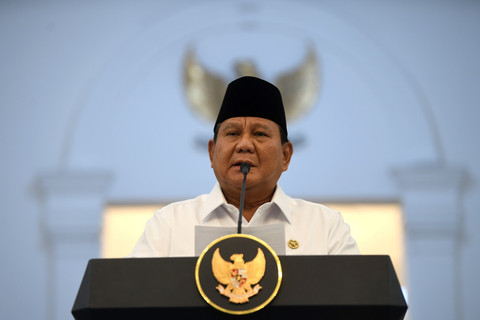

President Prabowo Subianto recently delivered a resounding message regarding the fundamental importance of the rule of law, asserting that it must be upheld diligently and without compromise. Speaking at the Indonesia Economic Outlook 2026 event held at Wisma Danantara, Jakarta, on Friday, February 13th, he explicitly warned against the misuse of legal instruments.
“My fellow citizens, we are resolute, and I am resolute: obey the law! There is no compromise. We must uphold the law properly,” Prabowo declared, emphasizing his unwavering commitment. He further stressed, “But there must be no miscarriage of justice. The law must not be used as a tool to persecute political opponents. Absolutely not.”

To underscore his commitment to these principles, Prabowo asserted that he has personally demonstrated this through significant acts of amnesty and abolition. Specifically, he highlighted granting amnesty to PDIP Secretary-General Hasto Kristiyanto and abolition to former Trade Minister Thomas Trikasih Lembong, also widely known as Tom Lembong.
“I have proven my courage to grant abolition, to grant amnesty if I believe there is an issue. Therefore, our courts must deliver fair judgments, beyond a reasonable doubt. Such decisions must be beyond a reasonable doubt, leaving no room for even the slightest doubt,” he elaborated. Prabowo further stated that if there is any possibility of a person’s innocence, no final verdict should be rendered against them, reinforcing the critical need for absolute certainty in legal proceedings.
President Subianto also explicitly affirmed his responsibility to guarantee legal certainty throughout Indonesia. He emphasized the profound link between a robust legal framework and national prosperity, stating, “Only with legal certainty can we guarantee stability and tranquility for our people. Our citizens must feel they live in a society where the government is clean and just. This is a prerequisite for the success of any nation.” His remarks highlight a vision for a country built on foundational principles of justice and public trust.

