
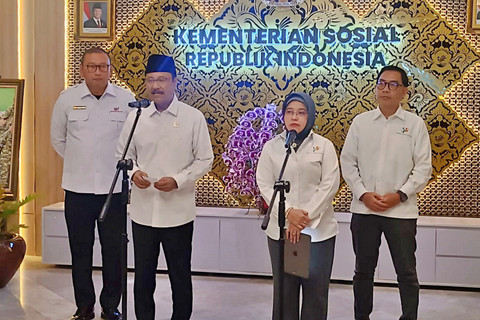

In a crucial move to safeguard social welfare, Minister of Social Affairs (Mensos) Saifullah Yusuf, widely known as Gus Ipul, convened a closed-door meeting with the Head of the Central Statistics Agency (BPS), Amalia Adininggar Widyasanti. The high-level discussion took place at the Ministry of Social Affairs office on Tuesday, February 10th, focusing intently on a pressing issue: the meticulous updating of data for BPJS Premium Assistance Recipients (PBI), particularly those grappling with catastrophic illnesses.
The urgency of this meeting stems from a significant challenge within the social safety net system. A staggering 11 million BPJS PBI recipients have recently had their assistance deactivated. Alarmingly, 106,153 of these deactivated individuals are patients suffering from catastrophic illnesses, a group critically dependent on continuous medical care and financial support.
Responding decisively to this concerning development, the Ministry of Social Affairs (Kemensos), in close collaboration with BPS, announced an immediate plan to conduct comprehensive field checks. This extensive ground verification will target all 106,153 individuals identified as deactivated PBI recipients with catastrophic illnesses. Gus Ipul emphasized that the core objective of this ambitious undertaking is to achieve robust data validation, ensuring that aid reaches those who genuinely need it most.
“My team and I, alongside Ibu Kepala BPS, are diligently following up on discussions from the DPR to initiate a thorough ground check on 106 thousand deactivated health insurance premium assistance recipients,” Gus Ipul stated. He further elaborated, “This effort is particularly focused on those with catastrophic illnesses who require uninterrupted treatment. We anticipate that this process will simultaneously serve as a vital mechanism for verifying and validating our data, ensuring accurate and equitable distribution of social assistance.”
Providing a timeline for this critical initiative, BPS Head Amalia confirmed that the actual field checks are slated to commence throughout March. Prior to this, the month of February will be dedicated to intensive training for the field officers, a necessary step given the widespread involvement of regional government apparatuses in the verification process.
“We have mutually agreed that the ground checks will be executed during the first and second weeks of March. Following the Lebaran holiday period, we anticipate the entire process to conclude by the end of March,” Amalia explained. She added, “By late March, all anomaly checks and subsequent data processing will be thoroughly completed, paving the way for informed decisions.”

Amalia further detailed the preparatory phase for this extensive operation. “During February, our focus will be on meticulous planning, rigorous officer training, and essential coordination with regional entities, especially local BPS offices,” she added. “Mensos also indicated that the field ground checks will receive crucial support from PKH (Family Hope Program) facilitators, working hand-in-hand with statistical partner officers and regional BPS employees, forming a robust verification team.”
In a move to provide immediate relief and ensure continuity of care, Gus Ipul announced that the BPJS PBI for all 106,153 recipients with catastrophic illnesses has been automatically reactivated. This activation, however, is temporary, with its status subject to an update following a comprehensive assessment of the economic conditions of each recipient.
“The more than 106 thousand individuals have been reactivated as of today, and this status will hold for the next three months,” Gus Ipul clarified. “We will subsequently evaluate the results to determine if they continue to meet the necessary eligibility requirements for continued assistance.”
Gus Ipul elaborated that the criteria for continued eligibility will primarily be based on the recipients’ Desil status, a socioeconomic indicator. Should recipients be identified within Desil 6-10, signifying a higher economic standing, they will be strongly advised to transition to BPJS Mandiri, the independent BPJS scheme.
“Those who meet the established requirements will, without a doubt, continue to receive this vital assistance. Conversely, those who do not meet the criteria will be guided towards becoming independent participants,” Gus Ipul asserted. “Ultimately, this thorough ground check is designed to definitively ascertain whether these beneficiaries genuinely belong to Desil 1 to 5, or if they fall into the higher Desil 6 to 10 categories, thereby ensuring fair and targeted social support.”
Summary
The Ministry of Social Affairs (Kemensos) and the Central Statistics Agency (BPS) will conduct door-to-door verification of BPJS Premium Assistance (PBI) data, specifically targeting 106,153 recipients with catastrophic illnesses whose assistance was recently deactivated. This urgent action follows a meeting between Mensos Saifullah Yusuf and BPS Head Amalia Adininggar Widyasanti to update data and ensure aid reaches those most in need. The extensive field checks are scheduled to commence throughout March, following intensive officer training in February.
To ensure continuity of care, the BPJS PBI for all 106,153 affected individuals has been temporarily reactivated for three months. Following the verification process, their eligibility will be assessed based on their Desil socioeconomic status. Those meeting the criteria (Desil 1-5) will continue receiving assistance, while others (Desil 6-10) will be advised to transition to the independent BPJS Mandiri scheme. This effort aims for fair and targeted social support.
